
Level: C1
Reading | Vocabulary | Activities | Speed Challenge | Shadow Reading and Typing | Questions | AI Prompts | Discussion | Language Focus | Resources
Printable: Student handout (PDF) | Teacher’s key (PDF)
Reading
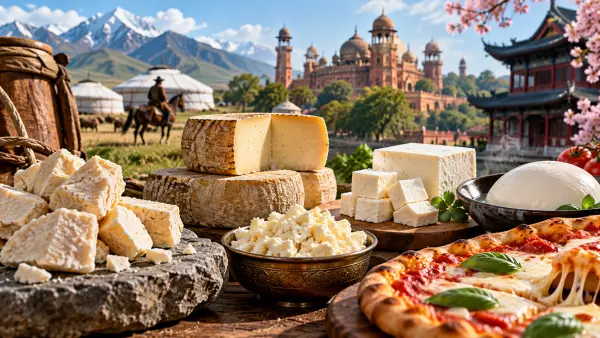
Open a bag at a market stall in the Himalayas and you may find what looks like a handful of pale stones. One is as hard as chalk. The seller suggests putting it in your mouth and waiting. Slowly, over many minutes, it softens enough to chew. This is chhurpi, a cheese made from yak and cow milk, and it is also exported to the United States, where it is sold mainly as a dog chew. The idea that cheese is a European invention with little connection to Asia is common. It is also a misconception.
The evidence for ancient dairy in Asia is solid. Proteins preserved in the dental plaque of people buried in Mongolia show that some of them ate dairy around 5,000 years ago. In China’s Tarim Basin, cheese made with kefir cultures was found on mummies about 3,600 years old, described as the oldest cheese ever found. The puzzle is that many adults across Asia cannot easily digest fresh milk. Cheese and soured milk offered a way around the problem, because much of the lactose, the sugar that causes the trouble, drains away with the whey or is broken down by bacteria. For early herders, cheese was less a luxury than a piece of practical ingenuity.
On the Eurasian steppe, the great problem was movement. European cheeses are often large wheels ripened slowly in cool cellars, which suits people who stay in one place. Mongolian, Kazakh, and Kyrgyz pastoralists lived differently, so they dried their milk. Curds were shaped into small lumps, set out on the roof of a tent, and stored for the winter. These foods, called aaruul in Mongolian and qurt in several Turkic languages, keep for a very long time. Fresh milk is perishable, and for people on the move, drying was the most reliable way to store it. Some food scholars argue that dried curds are not really cheese at all, but the hard, portable lump has long been a hallmark of steppe cooking.
In South Asia, the story turns on a technique. Paneer, the firm white cheese found in countless Indian dishes, is made by adding an acid such as lemon juice to hot milk. It needs no animal rennet, which makes it easy to use in vegetarian cooking. Where the technique came from is contested. Some sources credit Persian and Afghan arrivals, since the word itself comes from the Persian for cheese. Others argue that Portuguese settlers brought the method to seventeenth-century Bengal, and one theory adds that an older taboo against splitting milk had slowed its spread. What is certain is that fresh cheese became the base of eastern India’s best-known sweets. One of them, the rasgulla, caused such a quarrel over its origin that West Bengal and Odisha each ended up with protected-name status for their own version.
East Asia’s story is one of rise and fade. Dairy reached the Chinese court early, partly through Buddhism, which used milk in ritual and medicine, and historians see evidence of a substantial dairy industry under the Tang dynasty. Japan adopted the practice around the seventh century, and its court produced so, a dense food made by boiling milk down for hours. It was aristocratic patronage, not popular appetite, that sustained it, so when court power weakened in the late Heian period, the industry, historians suggest, began to dwindle. In China, dairy never disappeared completely. A Ming-dynasty text describes curdling milk with vinegar much as tofu is made, and in Yunnan the Bai people still make rushan, a fan-shaped cow’s-milk cheese that is a staple of local cooking.
Korea’s cheese history is short and unusually personal. In the 1960s, a Belgian priest named Didier t’Serstevens began keeping goats in the small town of Imsil to give struggling farmers an income, and he had to persuade them that cheese was like tofu made from milk. It was Imsil’s mozzarella that, according to one Korean newspaper, went into the country’s first pizza shop in 1972. Pizza, burgers, and bakeries have since carried cheese into everyday meals, though the pace differs across the region. Estimates from the late 2010s and early 2020s put average intake at roughly two to three kilograms a year in South Korea and Japan, but at under a third of a kilogram in China, against about 18 kilograms in Europe. Analysts say Chinese shoppers mostly buy processed slices, which suit the local palate better than strong natural cheeses, and cheese has made only modest inroads there.
Japan offers a final twist. When schools closed in early 2020, farmers lost one of their biggest customers and were left with a surplus of milk. Home cooks on social media began to revive so, the thousand-year-old dairy food, as a way to use it up. History had become a cooking trend. Which of Asia’s old cheeses, if any, will follow it into the mainstream next?
Vocabulary
Each word has a frequency score, a rank, and a tag. The score shows how common the word is in modern English: higher means more common, and each full point means roughly ten times more common. The rank is the word’s position on a list of about 321,000 English word forms, from most to least common. The tag shows where you are most likely to meet the word: Current, Formal, Literary, or Dated. The paragraph number shows where the word first appears in the reading. The labels are information, not instructions. Deciding which words are worth your time is up to you. How to read the scores, ranks, and tags.
misconception (noun): a mistaken belief that many people share about something.
Frequency: 3.22 | Rank: 21,798 | Current | Paragraph 1
Translations: 误解 | 誤解 | 오해 | गलत धारणा | فكرة خاطئة | заблуждение | idea errónea | idée fausse
- It is a misconception that cheese was unknown in Asia.
- There is a common misconception that you can catch a cold from cold weather alone.
ingenuity (noun): cleverness and imagination in solving a problem or making something.
Frequency: 3.23 | Rank: 21,516 | Formal | Paragraph 2
Translations: 独创性 | 創意工夫 | 독창성 | सूझबूझ | براعة | изобретательность | ingenio | ingéniosité
- Turning milk into cheese took real ingenuity.
- The villagers showed great ingenuity when they built a water pump from old bicycle parts.
pastoralists (noun, plural): people who raise grazing animals and often move with them to find fresh pasture.
Frequency: 2.31 | Rank: 65,913 | Formal | Paragraph 3
Translations: 牧民 | 牧畜民 | 목축민 | पशुपालक | رعاة | скотоводы | pastores | pasteurs
- Steppe pastoralists dried their milk so that it could travel with them.
- Pastoralists in dry regions often depend on the rains to find grass for their goats.
perishable (adjective): likely to go bad quickly unless it is kept cool, dried, or treated.
Frequency: 2.80 | Rank: 36,998 | Formal | Paragraph 3
Translations: 易腐坏的 | 傷みやすい | 상하기 쉬운 | जल्दी खराब होने वाला | سريع التلف | скоропортящийся | perecedero | périssable
- Fresh milk is perishable, so herders had to preserve it.
- Because fish is highly perishable, the market sells it on ice every morning.
hallmark (noun): a typical feature by which something is easily recognized.
Frequency: 3.37 | Rank: 17,813 | Formal | Paragraph 3
Translations: 标志性特征 | 特徴 | 특징 | विशिष्ट पहचान | سمة مميزة | отличительная черта | sello distintivo | marque distinctive
- Dried curds are a hallmark of steppe cooking.
- Careful editing is the hallmark of a good newspaper.
contested (adjective): argued over, with different people or groups claiming something different.
Frequency: 3.77 | Rank: 10,028 | Current | Paragraph 4
Translations: 有争议的 | 異論のある | 논란이 되는 | विवादित | محل خلاف | спорный | disputado | contesté
- The origin of paneer is contested.
- The ownership of the island has been contested for more than a century.
taboo (noun): a social or religious rule that forbids something as improper or offensive.
Frequency: 3.47 | Rank: 15,613 | Current | Paragraph 4
Translations: 禁忌 | タブー | 금기 | वर्जना | محظور | табу | tabú | tabou
- One theory mentions a taboo against deliberately splitting milk.
- In some families, talking about money is still a taboo.
patronage (noun): financial or social support given to artists, institutions, or industries by a wealthy person or group.
Frequency: 3.45 | Rank: 16,005 | Formal | Paragraph 5
Translations: 赞助 | 後援 | 후원 | संरक्षण | رعاية | покровительство | mecenazgo | mécénat
- Dairy in Japan depended on the patronage of the court.
- The theater survived for decades thanks to the patronage of a wealthy family.
dwindle (verb): to become gradually smaller, weaker, or fewer.
Frequency: 2.61 | Rank: 46,473 | Formal | Paragraph 5
Translations: 逐渐减少 | 次第に減る | 점차 줄어들다 | घटते जाना | يتضاءل | постепенно сокращаться | disminuir | diminuer
- Without the court’s support, the dairy industry began to dwindle.
- Interest in the old festival began to dwindle as young people moved to the cities.
staple (noun): a food or item that is eaten or used regularly and forms a main part of a diet.
Frequency: 3.68 | Rank: 11,541 | Current | Paragraph 5
Translations: 主食 | 主食 | 주식 | मुख्य भोजन | غذاء أساسي | основной продукт питания | alimento básico | aliment de base
- In Yunnan, rushan is a staple of local cooking.
- Rice is the staple food for billions of people.
palate (noun): a person’s sense of taste, or their preference for particular flavors.
Frequency: 3.35 | Rank: 18,297 | Formal | Paragraph 6
Translations: 口味 | 味覚 | 입맛 | स्वाद की पसंद | ذوق | вкус | paladar | palais
- Analysts say processed slices suit the local palate.
- The dish was too spicy for her sensitive palate.
inroads (noun, plural): gradual progress into a new area, market, or group of people.
Frequency: 2.88 | Rank: 33,636 | Formal | Paragraph 6
Translations: 进展 | 進出 | 진출 | पैठ | تغلغل | продвижение | avances | avancées
- Cheese has made only modest inroads in China.
- Electric cars are making inroads in markets that once used only petrol.
surplus (noun): an amount that is left over after what is needed has been used.
Frequency: 3.87 | Rank: 8,669 | Current | Paragraph 7
Translations: 过剩 | 余剰 | 잉여 | अधिशेष | فائض | излишек | excedente | excédent
- School closures left Japanese farmers with a surplus of milk.
- The bakery gives its surplus bread to a local shelter at the end of each day.
revive (verb): to bring something old back into use, popularity, or life.
Frequency: 3.68 | Rank: 11,541 | Current | Paragraph 7
Translations: 复兴 | 復活させる | 되살리다 | पुनर्जीवित करना | يُحيي | возродить | revivir | faire revivre
- Home cooks began to revive an ancient Japanese dairy food.
- The city hopes to revive its old tram line as a tourist attraction.
mainstream (noun): the ideas, tastes, or activities that most ordinary people accept.
Frequency: 4.26 | Rank: 4,589 | Current | Paragraph 7
Translations: 主流 | 主流 | 주류 | मुख्यधारा | التيار السائد | мейнстрим | corriente principal | courant dominant
- Will traditional Asian cheeses ever reach the mainstream?
- Once a niche hobby, board games have moved into the mainstream.
Activity Page
Open the activity page in a new tab
Speed Challenge
Answer 12 questions against the clock. Every wrong answer adds 5 seconds, and the lowest score wins. Open the speed challenge in a new tab.
Shadow Reading and Typing: My Kitchen Experiment
This short text uses many of the words from this lesson. Use it for shadow reading (reading aloud along with a model) and for typing practice.
For most of my life I held a common misconception about cheese. I believed it was a European food and little more. Then I read about hard chews from the Himalayas and dried curds from the steppe. My view changed quickly, and I began to admire the ingenuity behind them.
Last weekend I tried to imagine life as one of those pastoralists. Fresh milk is perishable, so every drop would matter. I would dry the curds on a roof and save them for the winter. It would be hard work, but I find the idea oddly calming. A hard, portable lump might even become the hallmark of my cooking.
Of course, my palate is used to soft cheese on pizza. Cheese has made slow inroads into my own diet, and I am no expert on the old traditions. Still, a staple that lasts for months would be useful in any kitchen. I would like to taste a real one someday.
Some questions about the past remain contested, and I will not pretend to know the answers. I do worry that such skills will dwindle if nobody practices them. So I want to revive one old recipe, and I will try not to waste any surplus. Maybe one day homemade foods like these will reach the mainstream.
How to practice
- Read the text silently once and check any words you are unsure of.
- Read it aloud slowly, one sentence at a time. On the typing page, the Listen button reads each line with your device’s voice, so you can listen first and then repeat.
- Shadow: read aloud again at a natural speed, trying to keep a steady rhythm without stopping.
- Record yourself, listen back, and note one sentence to practice again.
- Type it on the typing page below and check your speed and accuracy.
Open the typing practice in a new tab
Comprehension Questions
- Why does the writer begin with the example of chhurpi, and what common idea about cheese does it challenge?
- What two pieces of archaeological evidence does the reading give for ancient dairy in Asia?
- How did cheese and soured milk help people who could not easily digest fresh milk?
- Why were dried curds better suited to steppe herders than large cellar-ripened cheese wheels?
- Why does the writer say that dried curds may not count as cheese, and does this change the argument of the reading?
- How is paneer made, and what are the main theories about where the technique came from?
- According to the reading, why did the Japanese court’s dairy industry begin to decline, and how sure is the writer about this?
- What does the story of Imsil show about how new foods can take root in a country?
- The reading moves from ancient evidence to a modern trend in Japan. Why might the writer have chosen this order, and how does it affect the final question?
IELTS-Style Questions
- True, False, or Not Given: “Historians agree that paneer first came from Persia.” Explain your answer using evidence from the reading.
- Yes, No, or Not Given: “The writer believes that cheese has little connection to Asia.” Explain your answer using evidence from the reading.
- Author’s purpose: Why does the writer end the reading with a question? Is its purpose to predict the future, to leave the topic open, or something else?
AI Discussion Prompt
I just read an article about the history of cheese in Asia. It covered Himalayan chhurpi, ancient dairy evidence from Mongolia and the Tarim Basin, how cheese helped people who could not digest fresh milk, dried curds on the steppe, the disputed origin of paneer in South Asia, the rise and fade of dairy in China and Japan, the story of Imsil cheese in Korea, and the revival of an ancient dairy food in Japan in 2020. I am an English learner at about C1 level. Please ask me one question at a time, starting with whether there is a traditional food in my own country that people outside it might misunderstand. Respond to my ideas first, then briefly correct any language errors, and challenge my assumptions when it is useful.
AI Vocabulary Prompt
I want to practice vocabulary from an article about the history of cheese in Asia. Please quiz me on the following words one at a time, using a mix of question types: multiple choice, true/false, and sentence completion. Give me feedback after each answer before moving on, and bring back the words I miss later. Here are the words: misconception, ingenuity, pastoralists, perishable, hallmark, contested, taboo, patronage, dwindle, staple, palate, inroads, surplus, revive, mainstream.
Discussion Questions
- Do you eat cheese? If so, what kinds do you like, and when did you first try them?
- What is a food from your region that visitors often find strange at first? What would you say to help them try it?
- Is there a food in your family that was made to last through a long winter or a long journey? How was it prepared?
- The reading says many adults across Asia cannot easily digest fresh milk. Do you or people you know avoid dairy? How do people manage?
- The reading says dried curds may not count as cheese. Who should decide what a word like “cheese” means: scientists, cooks, governments, or ordinary speakers?
- Have you ever believed something about another country’s food that turned out to be wrong? What changed your mind?
- The reading says fresh cheese became the base of eastern India’s best-known sweets. Which foods in your country were invented by cooks who made use of whatever they had?
- Two Indian states each received protected-name status for their own rasgulla. Should a place be able to own the name of a food? Why or why not?
- The reading says Japan’s court dairy industry depended on aristocratic support. What happens to a food tradition when the group that supports it disappears?
- A priest in Imsil had to explain cheese to farmers by comparing it to tofu. What comparison would you use to introduce an unfamiliar food to someone?
- The reading says pizza, burgers, and bakeries have carried cheese into everyday meals. Is it good or bad when a global food becomes the default version of a local one?
- In early 2020, home cooks revived an ancient Japanese dairy food to help farmers. Can small personal choices, such as what we cook, really support local producers?
- The reading challenges the idea that cheese is a European invention. How could we make the history of other foods more global?
- Which of the old cheeses in the reading do you think has the best chance of reaching the mainstream, and what would it need to succeed?
Language Focus: Cleft Sentences for Emphasis
What it is: A cleft sentence splits one idea into two parts to put the most important information in focus. The main patterns are It + be + focus + that/who … and What + clause + be + focus.
Why writers use it: Writers use cleft sentences to correct an assumption, to contrast two possibilities, or to introduce a key point with extra weight. They are common in magazine writing and in spoken explanations.
Examples from the reading:
- “What is certain is that fresh cheese became the base of eastern India’s best-known sweets.”
- “It was aristocratic patronage, not popular appetite, that sustained it…”
- “It was Imsil’s mozzarella that, according to one Korean newspaper, went into the country’s first pizza shop in 1972.”
Practice task: Rewrite this sentence as a cleft sentence that stresses the underlined idea: Price and convenience will decide whether these cheeses succeed. Use It is … that or What … is.
(Example answer: “It is price and convenience that will decide whether these cheeses succeed. Or: What will decide whether these cheeses succeed is price and convenience.”)
Online Resources
- World’s oldest cheese found in China next to Bronze Age mummies (Cosmos). A readable report on the kefir cheese found on the Tarim Basin mummies, described in paragraph 2.
- 5000 Year Old Milk Proteins Point to the Importance of Dairying in Eastern Eurasia (Max Planck Institute for the Science of Human History). The research summary behind the Mongolian evidence in paragraph 2, with the species that people milked.
- Odisha Rasagola receives geographical indication tag; here’s what it means (Business Today). A short explanation of the rasgulla dispute in paragraph 4 and of what a protected-name tag does and does not prove.
- Milk, Yogurt and Butter in Medieval East Asia (Religions, open access). A scholarly article on how dairy foods moved from China to Japan, behind paragraph 5. It is a challenging read, so start with the introduction.
- Cheese pioneer given Korean citizenship (Korea JoongAng Daily). A profile of the priest behind Imsil cheese, with the story from paragraph 6 told in more detail.