
Level: B2
Before You Read | Reading | Vocabulary | Word Partners | Activities | Speed Challenge | Quick Reading | Questions | AI Prompts | Discussion | Language Focus | Resources
Printable: Student handout (PDF | Word) | Teacher’s key (PDF | Word)
Before You Read
Think about these questions or discuss them with a partner.
- Which young football players, men or women, can you name? What do you know about them?
- Did you play football or another team sport as a child? Which position or role did you enjoy, and why?
- How might the path to becoming a professional footballer differ from one country or region to another?
Reading
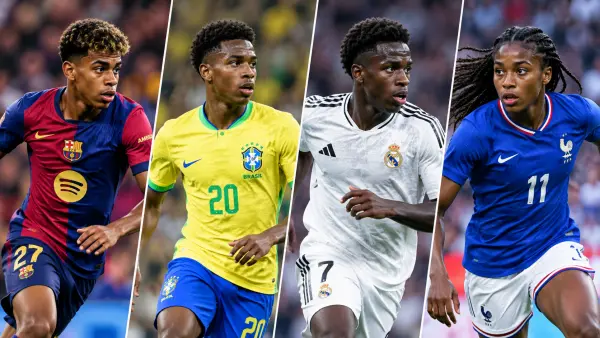
Picture the moment. A teenager receives the ball near the touchline, two defenders close in, and a whole stadium leans forward. Everyone knows what is coming, and still nobody can stop it. Football has always produced young stars, but the current crop has arrived unusually early and from very different places. Here are four of them, from four parts of the world, and a look at what makes each one so hard to play against.
Lamine Yamal, born near Barcelona in 2007, joined FC Barcelona’s famous academy as a child and played for the first team at 15. At the 2024 European Championship he became the youngest player ever to score at the tournament, and Spain went on to win it. He was then the first player to win the Kopa Trophy, the award for the world’s best player under 21, twice. Yamal plays on the right wing but prefers his left foot, so he loves to cut inside and curl the ball toward the far corner. His close control lets him change direction in a single touch. Even his admirers point to one flaw: his work without the ball, when the team needs him to chase opponents and help defend.
Then 2026 tested him. A hamstring injury in late April kept him out for about eight weeks, and he arrived at the World Cup in North America without his usual sharpness. Opponents often sent two defenders to mark him, and he scored only once. Yet Spain won the tournament, beating Argentina 1-0 after extra time in the final. Every defender assigned to Yamal was one fewer defender watching his teammates, a kind of influence that goal totals do not show.
Brazil’s Estêvão Willian, born the same year in Franca, is also a left-footed player on the right wing. As a boy he was nicknamed “Messinho,” or little Messi. He made his debut for Palmeiras at 16 and moved to Chelsea in 2025. According to reports, he became the youngest player since Pelé to score for Brazil in a competitive match. Coaches and commentators often praise his composure: he rarely rushes and seems to know exactly when to dribble and when to pass. In April 2026, however, he suffered a severe hamstring tear that ended his season and kept him out of the World Cup. He reportedly chose to recover without surgery, and he scored in his first game back that summer.
Yan Diomande took a far less direct route. He grew up playing barefoot in the streets of Abidjan, Ivory Coast, and at 15 he moved to a sports academy in Florida, where he did not speak the language. He went on trials at several European clubs, but they all came to nothing. Then Leganés, a small Spanish club, signed him at 18, and within a year he was in Germany with RB Leipzig. There he scored 12 goals, was named the Bundesliga’s best young player, and became the second-youngest player to score a hat trick in the league. In August 2026 he joined Real Madrid for a reported fee of about 140 million euros, which would make him the most expensive African player in history. He is fast, comfortable with both feet and on either wing, and he takes on defenders relentlessly: in Europe’s top five leagues in the 2025-26 season, only Yamal attempted more dribbles.
Melchie Dumornay, born in 2003 in Mirebalais, Haiti, is a few years older but just as striking. In 2023 she scored both goals in a playoff against Chile that sent Haiti to its first Women’s World Cup, and then she joined Lyon. She was named the Women’s Champions League young player of the season two years in a row, and in May 2026 the best player in France’s top league. Dumornay is hard to pin down. She drifts between midfield and attack, drops deep to collect the ball, and then surges past opponents or slides a pass behind the defense. She is also strong in the air, an unusual mix for such a quick player.
Put side by side, the four share two things: each can beat a defender one-on-one, and each reached an elite club as a teenager. Success that early can take a toll. Two of them spent the spring of 2026 recovering from serious hamstring injuries, and FIFPRO, the global players’ union, has warned that the match calendar has become too crowded, especially for young players. The union monitors the workload of many top players across club and country. Diomande’s new contract with Real Madrid runs until 2033, when he will be in his mid-twenties. How good he is by then may depend as much on rest as on talent.
Vocabulary
Each word has a frequency score, a rank, and a tag. The score shows how common the word is in modern English: higher means more common, and each full point means roughly ten times more common. The rank is the word’s position on a list of about 321,000 English word forms, from most to least common. The tag shows where you are most likely to meet the word: Current, Formal, Literary, or Dated. The paragraph number shows where the word first appears in the reading. The labels are information, not instructions. Deciding which words are worth your time is up to you. How to read the scores, ranks, and tags.
crop (noun): a group of people of the same kind who appear at about the same time, such as new players or graduates.
Frequency: 4.15 | Rank: 5,595 | Current | Paragraph 1
Translations: 一批 | 世代 | 세대 | खेप | دفعة | плеяда | hornada | fournée
- The current crop of young footballers arrived unusually early.
- This year’s crop of graduates is finding jobs quickly.
flaw (noun): a weakness or mistake in a person, plan, or object that stops it from being perfect.
Frequency: 3.60 | Rank: 12,940 | Current | Paragraph 2
Translations: 缺点 | 欠点 | 결점 | कमी | عيب | недостаток | defecto | défaut
- Even Yamal’s admirers point to one flaw in his game.
- The plan has one serious flaw: it costs too much.
sharpness (noun): here, the speed and quick reactions a player has after playing many games in a row.
Frequency: 3.01 | Rank: 28,556 | Current | Paragraph 3
Translations: 竞技状态 | 試合勘 | 경기 감각 | धार | الجاهزية | острота | chispa | tranchant
- After eight weeks out, Yamal lacked his usual sharpness.
- I lose my sharpness in English if I stop practicing for a month.
assigned (verb, past participle): given a particular job, task, or person to deal with.
Frequency: 4.39 | Rank: 3,683 | Current | Paragraph 3
Translations: 被分配 | 割り当てられた | 배정된 | नियुक्त | مُكلَّف | назначенный | asignado | assigné
- Every defender assigned to Yamal left space for his teammates.
- Each student was assigned a partner for the project.
composure (noun): the state of staying calm and in control, especially under pressure.
Frequency: 3.18 | Rank: 22,965 | Formal | Paragraph 4
Translations: 镇定 | 落ち着き | 침착함 | संयम | رباطة الجأش | самообладание | serenidad | sang-froid
- Commentators praise Estêvão’s composure on the ball.
- She kept her composure when the interviewer asked a difficult question.
trials (noun, plural): here, short periods in which a club tests a player before deciding whether to sign them.
Frequency: 4.32 | Rank: 4,153 | Current | Paragraph 5
Translations: 试训 | 入団テスト | 입단 테스트 | ट्रायल | اختبارات | просмотры | pruebas | essais
- Diomande went on trials at several European clubs.
- The orchestra holds trials for new violin players every spring.
came to nothing (verb phrase, past tense): failed to produce any result or success.
Frequency: no score (phrase) | Current | Paragraph 5
Translations: 落空 | 実を結ばなかった | 수포로 돌아갔다 | बेनतीजा रहे | ذهبت سدى | ни к чему не привели | quedaron en nada | n’ont rien donné
- His early trials in Europe came to nothing.
- Our plans for a summer trip came to nothing because of the weather.
relentlessly (adverb): in a determined way that does not stop or become weaker.
Frequency: 3.21 | Rank: 22,073 | Current | Paragraph 5
Translations: 不停地 | 執拗に | 끈질기게 | लगातार | بلا هوادة | неустанно | sin descanso | sans relâche
- Diomande takes on defenders relentlessly.
- The reporters questioned the minister relentlessly.
striking (adjective): very noticeable or impressive, so that people pay attention.
Frequency: 4.20 | Rank: 5,121 | Current | Paragraph 6
Translations: 引人注目的 | 際立った | 눈에 띄는 | उल्लेखनीय | لافت | яркий | llamativo | frappant
- Dumornay is just as striking as the younger players.
- There is a striking difference between the two photos.
pin down (phrasal verb): to hold someone in one place, or to describe or identify something exactly.
Frequency: no score (phrase) | Current | Paragraph 6
Translations: 抓住 | 捉える | 붙잡아 두다 | पकड़ना | يحدد | удержать | precisar | cerner
- Dumornay is hard to pin down because she moves around so much.
- Doctors could not pin down the cause of his headaches.
drifts (verb, third person): moves slowly or freely from one place to another, without a fixed path.
Frequency: 2.98 | Rank: 29,649 | Current | Paragraph 6
Translations: 游移 | 流れる | 떠돌다 | भटकती है | تتنقّل | смещается | se desplaza | se décale
- Dumornay drifts between midfield and attack.
- His attention drifts when a lesson goes on too long.
surges (verb, third person): moves forward suddenly and powerfully.
Frequency: 3.05 | Rank: 27,150 | Current | Paragraph 6
Translations: 冲 | 突進する | 돌진하다 | झपटती है | تندفع | рвётся вперёд | irrumpe | s’élance
- Dumornay surges past opponents with the ball.
- When the doors open, the crowd surges forward.
elite (adjective): among the best or most powerful of a group.
Frequency: 4.40 | Rank: 3,612 | Current | Paragraph 7
Translations: 精英 | エリート | 엘리트 | शीर्ष | النخبة | элитный | de élite | d’élite
- Each of the four players reached an elite club as a teenager.
- Only elite athletes can run a marathon that fast.
take a toll (verb phrase): to cause harm or damage, often slowly or over a long time.
Frequency: no score (phrase) | Current | Paragraph 7
Translations: 造成损害 | 悪影響を及ぼす | 타격을 주다 | नुकसान पहुँचाना | يُلحق الضرر | сказываться | pasar factura | avoir un coût
- A crowded calendar can take a toll on young players.
- Years of night shifts can take a toll on your health.
workload (noun): the amount of work or activity that a person has to do.
Frequency: 3.45 | Rank: 16,005 | Current | Paragraph 7
Translations: 负荷 | 負荷 | 부하 | काम का बोझ | عبء العمل | нагрузка | carga de trabajo | charge de travail
- FIFPRO monitors the workload of many top players.
- My workload is heavier at the end of every semester.
Word Partners
Collocations. Match the two halves to make common phrases. Then use three of the phrases in sentences of your own.
| 1. a fatal | a. composure |
| 2. lose your | b. relentlessly |
| 3. be assigned | c. toll |
| 4. a striking | d. flaw |
| 5. at the elite | e. resemblance |
| 6. take a heavy | f. workload |
| 7. reduce a player’s | g. level |
| 8. work | h. to a task |
Answers
- a fatal flaw (d)
- lose your composure (a)
- be assigned to a task (h)
- a striking resemblance (e)
- at the elite level (g)
- take a heavy toll (c)
- reduce a player’s workload (f)
- work relentlessly (b)
Word families. Complete each sentence with the correct form of the word in brackets.
- Even when the crowd booed, she stayed calm and __________. (composure)
- The goalkeeper gave a __________ performance and made no mistakes at all. (flaw)
- The two brothers look __________ alike. (striking)
- The coach gave each player a different __________ for the training session. (assigned)
- The team kept up a __________ pace for the whole match. (relentlessly)
- A __________ striker needs only one chance to score. (sharpness)
Answers
- composed
- flawless
- strikingly
- assignment
- relentless
- sharp
Activity Page
Open the activity page in a new tab
Speed Challenge
Answer 12 questions against the clock. Every wrong answer adds 5 seconds, and the lowest score wins. Open the speed challenge in a new tab.
Quick Reading and Typing: Four Young Stars in Brief
A shorter version of the reading that uses the lesson vocabulary. Read it for a quick introduction to the topic, or use it for reading aloud, shadowing (reading along with a model), and typing practice.
Football has always produced young stars, but the current crop arrived unusually early and from very different places. Lamine Yamal was born near Barcelona in 2007 and played for the club’s first team at 15. At the 2024 European Championship, he became the youngest player ever to score at the tournament. He was also the first player to win the Kopa Trophy twice. It is the award for the best player under 21. Yamal plays on the right wing but prefers his left foot. Even his admirers say he has one flaw: his work without the ball.
In 2026, a hamstring injury cost Yamal his sharpness, and he scored only once at the World Cup. Still, every defender assigned to him left more space for his teammates, and Spain won the tournament. Estêvão Willian of Brazil, born the same year, is also a left-footed player on the right wing. He moved from Palmeiras to Chelsea in 2025. Many people praise his composure, because he seems to know when to dribble and when to pass. A serious hamstring injury in April 2026 kept him out of the World Cup, but he scored in his first game back.
Yan Diomande grew up in Abidjan, Ivory Coast, and moved to an academy in Florida at 15. His trials at several European clubs came to nothing. Then a small Spanish club signed him, and a year later he was in Germany with RB Leipzig. In August 2026, Real Madrid signed him for a reported fee of about 140 million euros. He is fast, uses both feet, and takes on defenders relentlessly.
Melchie Dumornay of Haiti, born in 2003, is a few years older but just as striking. In 2023, her two goals against Chile sent Haiti to its first Women’s World Cup. At Lyon, she is hard to pin down. She drifts between midfield and attack, and then she surges past opponents or slides a pass behind the defense.
All four reached an elite club as teenagers, and success that early can take a toll. Two of them had serious hamstring injuries in 2026. FIFPRO, the global players’ union, has warned that the workload is too heavy, especially for young players.
How to practice
- Read the text silently once and check any words you are unsure of.
- Read it aloud slowly, one sentence at a time. On the typing page, the Listen button reads each line with your device’s voice, so you can listen first and then repeat.
- Shadow: read aloud again at a natural speed, trying to keep a steady rhythm without stopping.
- Record yourself, listen back, and note one sentence to practice again.
- Type it on the typing page below and check your speed and accuracy.
Open the typing practice in a new tab
Comprehension Questions
- When and where was Lamine Yamal born, and how old was he when he first played for the first team?
- What record did Yamal set at the 2024 European Championship?
- What weakness do even Yamal’s admirers mention?
- Yamal scored only once at the 2026 World Cup. How did he still help Spain?
- Why did Estêvão miss the 2026 World Cup?
- What do many people praise about the way Estêvão plays?
- Describe Yan Diomande’s route from Abidjan to Real Madrid.
- What did Melchie Dumornay do for Haiti in 2023, and why is she hard to pin down?
- Why might early success take a toll on young players? Use the reading and your own ideas.
IELTS-Style Questions
- True, False, or Not Given: “Melchie Dumornay has won the Women’s Champions League with Lyon.” Explain your answer using the reading.
- Yes, No, or Not Given: “The writer suggests that a heavy workload may be a risk for young players.” Explain your answer using the reading.
- Author’s purpose: Why does the writer mention FIFPRO? Is it (a) to show that the players’ own union is worried about workload, (b) to explain how much players are paid, or (c) to name the organization that runs the World Cup?
AI Discussion Prompt
I just read an article about a new generation of football stars: Lamine Yamal of Spain, Estêvão Willian of Brazil, Yan Diomande of Ivory Coast, and Melchie Dumornay of Haiti. It described how each one plays, their very different paths to elite clubs, the injuries two of them had in 2026, and warnings from the players’ union FIFPRO about heavy workloads for young players. I am an English learner at about B2 level. Please ask me one question at a time, starting with which of these players I would most like to watch. Respond to my ideas first, then briefly correct any language errors, and ask follow-up questions that make me explain and support my opinions.
AI Vocabulary Prompt
I want to practice vocabulary from an article about a new generation of football stars. Please quiz me on the following words one at a time, using a mix of question types: multiple choice, true/false, and sentence completion. Give me feedback after each answer before moving on, and bring back the words I miss later. Here are the words: crop, flaw, sharpness, assigned, composure, trials, came to nothing, relentlessly, striking, pin down, drifts, surges, elite, take a toll, workload.
Discussion Questions
- Which of the four players would you most like to watch, and why?
- Do you enjoy watching players who dribble a lot, or players who pass quickly? Why?
- Who is the most exciting young athlete in a sport you follow, and what makes them stand out?
- When you were younger, did you dream of becoming a professional athlete or performer? What happened to that dream?
- Yamal is famous for his attacking skill but has a weakness in defense. Is it better to be excellent at one thing or good at everything?
- Can you remember a time when you had to keep your composure under pressure? What helped you?
- Diomande’s early trials came to nothing. What can people learn from early rejection?
- Should a talented teenager stay at a smaller club longer, or move to a big club as soon as possible? Why?
- Can a transfer fee of about 140 million euros for one player ever be reasonable? Why or why not?
- Women’s football is growing in many countries. What would make it more popular where you live?
- How can talented young people in poorer regions get a fair chance to be seen by top clubs?
- Who should decide how many matches a player plays: the player, the club, the national team, or a union?
- Should there be limits on how many matches teenage athletes can play, even if fans want to see them?
- Does early fame help or harm young people, in sport or in other fields?
Language Focus: Superlatives and Ordinals with the To-Infinitive
What it is: After a superlative (the youngest, the best, the most expensive) or an ordinal word (the first, the second, the last, the only), English often uses a noun and then to + base verb. The pattern is: the + superlative or ordinal + noun + to-infinitive. It means “the person or thing who did this”.
Why writers use it: This pattern is common in sports reports and news, because records are about who did something first, last, or at the youngest age. It is shorter than a relative clause: “the first player to win” means “the first player who won”.
Examples from the reading:
- “At the 2024 European Championship he became the youngest player ever to score at the tournament…”
- “He was then the first player to win the Kopa Trophy…”
- “…he became the youngest player since Pelé to score for Brazil in a competitive match.”
- “…and became the second-youngest player to score a hat trick in the league.”
Part A. Sentence starters Finish each sentence so that it is true for you.
Ordinals (first, last, only)
- The first person in my family to …
- In my home, the last person to go to bed is usually …
- The only place in my town to …
Superlatives (best, easiest, most)
- For me, the easiest way to learn new words is …
- The best time of day to study is …
Model answers
- The first person in my family to go to university was my older sister.
- In my home, the last person to go to bed is usually my father.
- The only place in my town to watch live football is the stadium by the river.
- For me, the easiest way to learn new words is to use them in short messages.
- The best time of day to study is early in the morning.
Part B. Questions Answer each question in a full sentence. Try to answer using the + superlative or ordinal + noun + to-infinitive. Then ask a partner.
- Who was the first person in your class to get a smartphone?
- What is the best place in your city to meet friends?
- Who was the last person to send you a message today?
- What is the most useful thing to bring on a long trip?
- Who is the oldest person you know to still play a sport?
Model answers
- My friend Dan was the first person in our class to get a smartphone.
- The best place to meet friends is the park near the station.
- My cousin was the last person to send me a message today.
- The most useful thing to bring on a long trip is a phone charger.
- My grandfather is the oldest person I know to still play tennis.
Online Resources
- Lamine Yamal position and style of play (Coaches’ Voice). A coach’s view of how Yamal plays on the right, cuts inside, and could improve without the ball (paragraph 2). It was written in 2023, early in his career.
- Estêvão Willian (Wikipedia). A timeline of Estêvão’s career, from Palmeiras to Chelsea and the Brazil national team, including his 2026 injury.
- How Yan Diomande went from a Florida academy to Real Madrid (Sports Illustrated). The full story of Diomande’s journey in paragraph 5, from Abidjan to Florida, Spain, Germany, and Madrid.
- Melchie Dumornay (Wikipedia). Dumornay’s career with Haiti, Reims, and Lyon, and a list of her awards.
- Player workload in sharp focus at International Sports Convention in London (FIFPRO). The players’ union explains why it thinks the football calendar is too crowded (paragraph 7).