

Level: B2. Reading at B2. The word lists range from B1 to C1 on purpose; frequency scores show which words are common.
Introduction | Word Family | Collocations | Patterns | Expressions | Synonyms and Antonyms | Activities | Speed Challenge | Shadow Reading and Typing | Quotations | Discussion | AI Prompt | Resources
Printable: Student activity handout (PDF) | Teacher’s key (PDF)
Travel: Why We Go, and Why We Come Back
Travel is one of the few things that most people would happily spend more time and money on. A trip breaks the routine of daily life: the alarm clock, the commute, the same streets. On the road, ordinary things become interesting again. A bus ticket, a strange breakfast, or a chat with a stranger can turn into a story we tell for years. For many people, simply looking forward to a trip is part of the pleasure.
Travel comes in many forms. Some people get itchy feet after a few months at home and dream of places off the beaten path. Others prefer to travel light, see the sights, and come home quickly. Business travelers may live out of a suitcase for weeks, while homebodies are happy to stay put. Whatever our style, most of us return with new questions about the world, and with a new appreciation for the words “home sweet home.”
This page explores the idea of travel and the language we use to talk about it. You will find word forms, common mistakes, collocations, preposition patterns, expressions from “itchy feet” to “home sweet home,” synonyms and opposites, interactive activities, quotations, discussion questions, and a practice text for shadow reading and typing.
Word Family
Translations throughout this page are in this order: Chinese | Japanese | Korean | Hindi | Arabic | Russian | Spanish | French. Single words show a frequency score and rank. How to read the scores and ranks.
travel (verb) /ˈtrævəl/: to go from one place to another, especially over a long distance.
Frequency: 5.00 | Rank: 1,076 (for travel, all uses)
She travels to her hometown every summer.
Translations: 旅行, 出行 | 旅行する, 移動する | 여행하다, 이동하다 | यात्रा करना | يسافر | путешествовать, ездить | viajar | voyager
travel (noun, uncountable) /ˈtrævəl/: the general activity of going to other places, for pleasure or for work.
Air travel has become much cheaper since the 1990s.
Translations: 旅行, 出行 | 旅行, 移動 | 여행, 이동 | यात्रा | السفر | путешествия, поездки | los viajes | les voyages
traveler (noun (UK: traveller)) /ˈtrævələr/: a person who is on a journey, or who travels often.
Frequency: 3.57 | Rank: 13,496
The station was full of tired travelers.
Translations: 旅行者, 旅客 | 旅行者, 旅人 | 여행자 | यात्री | مسافر | путешественник | viajero | voyageur
travels (noun, plural) /ˈtrævəlz/: a person’s journeys, especially long ones to many places.
Frequency: 4.05 | Rank: 6,565 (for travels, noun and verb)
She writes a blog about her travels in South America.
Translations: 游历 | 旅, 旅の経験 | 여행 경험, 여정 | यात्राएँ | رحلات | путешествия, странствия | viajes | voyages
well-traveled (adjective (UK: well-travelled)) /ˌwel ˈtrævəld/: having traveled to many places.
My aunt is well-traveled and has stories from every continent.
Translations: 游历广泛的 | 旅の経験が豊富な | 여행 경험이 많은 | बहुत घूमा हुआ | كثير الترحال | много путешествовавший | muy viajado | qui a beaucoup voyagé
travelogue (noun) US /ˈtrævəlɔːɡ/, UK /ˈtrævəlɒɡ/: a film, book, or talk about someone’s travels.
Frequency: 2.46 | Rank: 55,433
He made a video travelogue of his train ride across Canada.
Translations: 游记 | 旅行記 | 여행기 | यात्रा वृत्तांत | أدب الرحلات | путевые заметки | relato de viajes | récit de voyage
Common mistakes
- Travel is usually uncountable. Say How was your trip?, not How was your travel?, and We took a trip, not a travel. The plural travels is used for a long series of journeys: on her travels.
- Travel to a place, but travel abroad. Say travel to Spain, not travel Spain. (With a whole area, no preposition is fine: travel the world.) Abroad and overseas never take to: go abroad, not go to abroad.
- By train, but in my car. Use by with no article: by bus, by plane. With my, a, or the, use in or on: in my car, on the train. Walking is on foot.
- Trip, journey, or voyage? A trip usually means going somewhere and coming back (a day trip). A journey is the act of getting from one place to another (The journey took six hours). A voyage is long and usually by sea or in space.
- Spelling: traveled or travelled. American English uses one l: traveled, traveling, traveler. British English doubles it: travelled, travelling, traveller. Both are correct; just be consistent.
Collocations
Collocations are words that often go together. For a longer list, see travel on OZDIC, a free collocation dictionary.
Travel + adverb
These describe how or where you travel.
travel abroad: to travel to another country.
More students now travel abroad for part of their degree.
Translations: 出国旅行 | 海外旅行する | 해외여행을 하다 | विदेश यात्रा करना | يسافر إلى الخارج | ездить за границу | viajar al extranjero | voyager à l’étranger
travel light: to take very little luggage.
I always travel light, with one small bag even for two weeks.
Translations: 轻装出行 | 身軽に旅をする | 짐을 가볍게 하고 여행하다 | कम सामान के साथ यात्रा करना | يسافر بأمتعة خفيفة | путешествовать налегке | viajar ligero de equipaje | voyager léger
travel extensively (formal): to travel to many places over a wide area.
She has traveled extensively in Central Asia.
Translations: 广泛游历 | 広く旅をする | 여러 곳을 두루 여행하다 | व्यापक रूप से यात्रा करना | يسافر كثيرًا | много путешествовать | viajar mucho | beaucoup voyager
travel solo: to travel alone.
Traveling solo makes you talk to strangers.
Translations: 独自旅行 | 一人旅をする | 혼자 여행하다 | अकेले यात्रा करना | يسافر بمفرده | путешествовать в одиночку | viajar solo | voyager seul
Kinds of travel
air travel: traveling by plane.
Air travel produces a large share of a tourist’s carbon footprint.
Translations: 航空旅行 | 空の旅 | 항공 여행 | हवाई यात्रा | السفر جوًا | авиаперелёты | viajes en avión | voyages en avion
business travel: traveling for work.
Video calls have replaced some business travel.
Translations: 商务出行 | 出張 | 출장 | व्यावसायिक यात्रा | سفر العمل | деловые поездки | viajes de negocios | voyages d’affaires
international travel: travel between countries.
International travel fell sharply in 2020.
Translations: 国际旅行 | 国際旅行, 海外旅行 | 해외여행 | अंतरराष्ट्रीय यात्रा | السفر الدولي | международные поездки | viajes internacionales | voyages internationaux
space travel: traveling into space.
Space travel is still far too expensive for most people.
Translations: 太空旅行 | 宇宙旅行 | 우주여행 | अंतरिक्ष यात्रा | السفر إلى الفضاء | космические путешествия | viajes espaciales | voyages spatiaux
Travel + noun: planning
travel plans: decisions about where and when you will travel.
The storm changed everyone’s travel plans.
Translations: 旅行计划 | 旅行の計画 | 여행 계획 | यात्रा की योजना | خطط السفر | планы поездки | planes de viaje | projets de voyage
travel arrangements: the tickets, bookings, and details organized before a trip.
My assistant handles all my travel arrangements.
Translations: 行程安排 | 旅行の手配 | 여행 준비 | यात्रा की व्यवस्था | ترتيبات السفر | организация поездки | preparativos del viaje | préparatifs de voyage
travel insurance: insurance that pays if you get sick, lose things, or cancel a trip.
Travel insurance paid her hospital bill in Peru.
Translations: 旅行保险 | 旅行保険 | 여행자 보험 | यात्रा बीमा | تأمين السفر | туристическая страховка | seguro de viaje | assurance voyage
travel expenses: money spent on transport, hotels, and meals during a trip, especially for work.
The company pays travel expenses for the conference.
Translations: 差旅费 | 旅費, 交通費 | 출장비, 여행 경비 | यात्रा खर्च | نفقات السفر | дорожные расходы | gastos de viaje | frais de déplacement
Travel + noun: people and places
travel agent: a person or company that books trips for customers.
A travel agent found us a cheaper route through Istanbul.
Translations: 旅行代理人 | 旅行代理店(の担当者) | 여행사 직원 | ट्रैवल एजेंट | وكيل سفر | турагент | agente de viajes | agent de voyages
travel destination: a place that people travel to.
The island has become a popular travel destination.
Translations: 旅游目的地 | 旅行先 | 여행지 | पर्यटन स्थल | وجهة سياحية | туристическое направление | destino turístico | destination de voyage
travel companion: a person who travels with you.
My sister is my favorite travel companion.
Translations: 旅伴 | 旅の道連れ | 여행 동반자 | हमसफ़र | رفيق السفر | попутчик | compañero de viaje | compagnon de voyage
travel ban: an official order that stops people traveling to or from a place.
The travel ban was lifted after three months.
Translations: 旅行禁令 | 渡航禁止 | 여행 금지 조치 | यात्रा प्रतिबंध | حظر السفر | запрет на поездки | prohibición de viajar | interdiction de voyager
Trip, not travel
Use trip for one journey that goes somewhere and comes back.
take a trip: to go somewhere for a short time and come back.
We took a trip to the mountains last weekend.
Translations: 去旅行 | 旅行に出かける | 여행을 가다 | सैर पर जाना | يقوم برحلة | съездить, отправиться в поездку | hacer un viaje | faire un voyage
a day trip: a trip where you go and return on the same day.
Kyoto is an easy day trip from Osaka.
Translations: 一日游 | 日帰り旅行 | 당일치기 여행 | एक दिन की सैर | رحلة ليوم واحد | однодневная поездка | excursión de un día | excursion d’une journée
a business trip: a trip made for work.
He’s away on a business trip until Friday.
Translations: 出差 | 出張 | 출장 | व्यावसायिक दौरा | رحلة عمل | командировка | viaje de negocios | voyage d’affaires
a round trip (mainly American): a trip to a place and back again.
The round trip takes about four hours.
Translations: 往返 | 往復 | 왕복 여행 | आने-जाने की यात्रा | رحلة ذهاب وعودة | поездка туда и обратно | viaje de ida y vuelta | aller-retour
Preposition Patterns
These patterns show where you travel (to, from, around, through, across) and how (by, on).
travel to (a place): to go to a place on a journey.
We’re traveling to Morocco in May.
Translations: 前往… | …へ旅行する | …로 여행하다 | … की यात्रा करना | يسافر إلى … | ехать в … | viajar a … | voyager à / en …
travel from … to …: to go from one place to another.
They traveled from Nairobi to Mombasa by train.
Translations: 从…到… | …から…まで移動する | …에서 …까지 이동하다 | … से … तक यात्रा करना | يسافر من … إلى … | ехать из … в … | viajar de … a … | voyager de … à …
travel around: to visit many places in an area.
After graduating, he traveled around Southeast Asia for six months.
Translations: 周游 | …を旅して回る | …을 두루 여행하다 | … में घूमना | يتجوّل في … | путешествовать по … | recorrer … | parcourir …
travel through: to pass through a place on the way somewhere else.
The train travels through three countries.
Translations: 穿过, 途经 | …を通って行く | …을 거쳐 가다 | … से होकर जाना | يمرّ عبر … | проезжать через … | atravesar … | passer par …
travel across: to go from one side of a large area to the other.
They traveled across the desert by camel.
Translations: 横穿 | …を横断する | …을 횡단하다 | … के पार जाना | يعبر … | пересекать … | cruzar … | traverser …
travel by (bus, car, plane): to use a particular kind of transport.
It’s cheaper to travel by bus.
Translations: 乘…出行 | …で行く | …로 이동하다 | … से यात्रा करना | يسافر بـ… | ехать на … | viajar en … | voyager en …
on foot: walking.
The old town is best explored on foot.
Translations: 步行 | 徒歩で | 걸어서 | पैदल | سيرًا على الأقدام | пешком | a pie | à pied
be on a trip: to be away from home, traveling.
Sorry I missed your call. I was on a trip to Hanoi.
Translations: 在旅行中 | 旅行中である | 여행 중이다 | यात्रा पर होना | في رحلة | быть в поездке | estar de viaje | être en voyage
Expressions: From Itchy Feet to Home Sweet Home
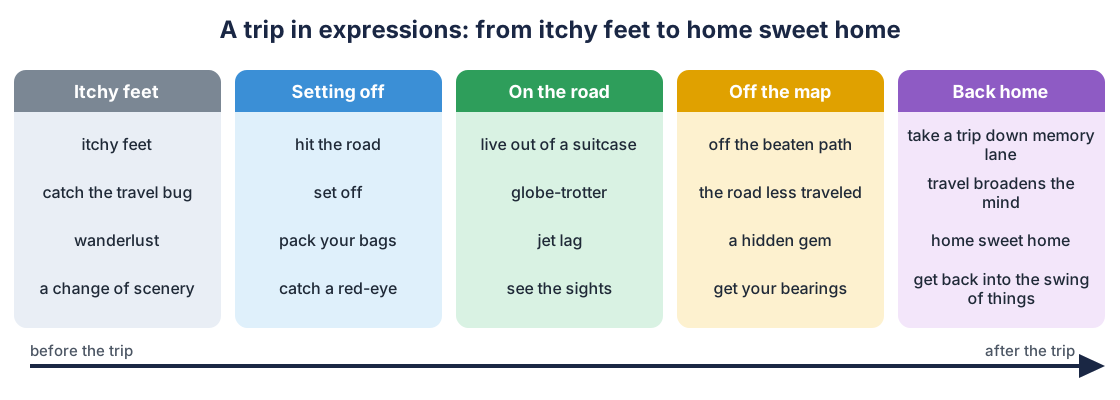
These idioms and phrases follow a trip from start to finish: the wish to go, setting off, life on the road, unusual places, and coming home.
Itchy feet
The wish to go somewhere
itchy feet (informal): a strong wish to travel or move somewhere new.
After two years in the same job, I’m getting itchy feet.
Translations: 想出去走走的冲动 | 旅に出たくてうずうずすること | 떠나고 싶은 마음 | घूमने की बेचैनी | رغبة ملحّة في السفر | тяга к перемене мест | ganas de viajar | la bougeotte
catch the travel bug: to start to love traveling and want to do it more.
She caught the travel bug on a school trip to Italy.
Translations: 爱上旅行 | 旅行にはまる | 여행에 빠지다 | घूमने का शौक़ लग जाना | يُصاب بشغف السفر | заразиться страстью к путешествиям | picarle a uno el gusanillo de viajar | attraper le virus du voyage
wanderlust (noun): a strong desire to travel.
Frequency: 2.65 | Rank: 44,209
Old travel photos filled him with wanderlust.
Translations: 对旅行的渴望 | 旅への憧れ | 방랑벽, 여행 욕구 | घुमक्कड़ी | شغف الترحال | страсть к странствиям | ansias de viajar | envie de voyager
a change of scenery: a different place that makes you feel refreshed.
A weekend by the sea gave us a much-needed change of scenery.
Translations: 换个环境 | 環境を変えること, 気分転換 | 환경의 변화, 기분 전환 | माहौल में बदलाव | تغيير الجو | смена обстановки | un cambio de aires | un changement de décor
Setting off
Starting the journey
hit the road (informal): to start a journey.
We hit the road before sunrise to beat the traffic.
Translations: 上路 | 出発する | 길을 나서다 | सफ़र पर निकलना | ينطلق في الطريق | отправиться в путь | ponerse en camino | prendre la route
set off: to leave and begin a journey.
We set off for the airport at six.
Translations: 出发 | 出発する | 출발하다 | रवाना होना | ينطلق | отправиться | salir, partir | se mettre en route
pack your bags: to get ready to leave, sometimes for good.
She packed her bags and moved to Lisbon.
Translations: 收拾行李 | 荷物をまとめる | 짐을 싸다 | बोरिया-बिस्तर बाँधना | يحزم حقائبه | собрать вещи | hacer las maletas | faire ses valises
catch a red-eye (informal, mainly American): to take a late-night flight that arrives early in the morning.
I caught the red-eye and went straight to a meeting.
Translations: 搭红眼航班 | 夜行便に乘る | 야간 비행기를 타다 | रात की उड़ान पकड़ना | يستقلّ رحلة ليلية | лететь ночным рейсом | tomar un vuelo nocturno | prendre un vol de nuit
On the road
Life while traveling
live out of a suitcase: to travel so often that you never fully unpack.
During the tour, the band lived out of a suitcase for months.
Translations: 四处奔波, 居无定所 | スーツケース一つで暮らす | 떠돌이 생활을 하다 | सूटकेस के सहारे जीना | يعيش متنقّلًا بحقيبته | жить на чемоданах | vivir con la maleta a cuestas | vivre dans sa valise
globe-trotter (noun, informal): a person who travels to many countries.
My uncle is a real globe-trotter: he has visited over 60 countries.
Translations: 环球旅行者 | 世界中を旅する人 | 세계 여행가 | विश्व भ्रमणकारी | رحّالة | путешественник по миру | trotamundos | globe-trotteur
jet lag (noun): tiredness after a long flight across time zones.
It took me three days to get over the jet lag.
Translations: 时差反应 | 時差ぼけ | 시차증 | जेट लैग | اضطراب فارق التوقيت | джетлаг | desfase horario | décalage horaire
see the sights: to visit the famous places in a town or area.
We spent the first day seeing the sights of Istanbul.
Translations: 观光 | 名所を見物する | 명소를 구경하다 | दर्शनीय स्थल देखना | يزور المعالم | осматривать достопримечательности | ver los lugares de interés | visiter les sites touristiques
Off the map
Unusual places and paths
off the beaten path (UK: off the beaten track): far from the places most tourists visit.
We found a tiny village off the beaten path.
Translations: 人迹罕至的地方 | 人があまり行かない場所に | 인적이 드문 곳에 | आम रास्ते से हटकर | بعيدًا عن المسارات المألوفة | вдали от проторённых троп | fuera de los circuitos turísticos | hors des sentiers battus
the road less traveled: an unusual choice that most people do not make.
Instead of law school, she took the road less traveled and became a chef.
Translations: 少有人走的路 | 人があまり通らない道 | 남들이 가지 않은 길 | कम चुना गया रास्ता | الطريق الأقل ارتيادًا | непроторённая дорога | el camino menos transitado | le chemin le moins fréquenté
a hidden gem: a great place that few people know about.
This little café is a hidden gem.
Translations: 鲜为人知的好地方 | 隠れた名所 | 숨은 명소 | छिपा हुआ रत्न | جوهرة خفيّة | скрытая жемчужина | una joya escondida | une pépite cachée
get your bearings: to find out where you are, or get used to a new place.
It took me a day to get my bearings in Tokyo.
Translations: 弄清方向 | 方向をつかむ | 방향을 파악하다 | दिशा का अंदाज़ा लगाना | يحدّد موقعه | сориентироваться | orientarse | trouver ses repères
Back home
After the trip
take a trip down memory lane: to remember happy times from the past.
We took a trip down memory lane with our old travel photos.
Translations: 重温往事 | 思い出にふける | 추억 여행을 하다 | यादों की गलियों में घूमना | يستعيد الذكريات | предаться воспоминаниям | recordar viejos tiempos | faire un retour dans le passé
travel broadens the mind (saying): traveling helps you understand people and ideas.
They say travel broadens the mind, and my year in Ghana certainly did.
Translations: 旅行开阔眼界 | 旅は視野を広げる | 여행은 견문을 넓혀 준다 | यात्रा सोच का दायरा बढ़ाती है | السفر يوسّع الآفاق | путешествия расширяют кругозор | viajar abre la mente | les voyages forment la jeunesse
home sweet home: said when you are happy to be back at home.
After three weeks away, I dropped my bags and said, “Home sweet home.”
Translations: 还是家里好 | やっぱり我が家が一番 | 역시 우리 집이 최고 | अपना घर अपना ही होता है | لا مكان مثل البيت | дом, милый дом | hogar, dulce hogar | rien ne vaut son chez-soi
get back into the swing of things (informal): to return to normal routines after a break.
After my holiday, it took a week to get back into the swing of things.
Translations: 重新适应日常节奏 | 日常のペースに戻る | 일상으로 돌아오다 | फिर से पुरानी लय में आना | يعود إلى روتينه | войти в привычный ритм | retomar el ritmo | reprendre le rythme
Synonyms and Antonyms
No synonym means exactly the same as travel. The notes explain the differences. The opposites describe people and plans that stay close to home.
Synonyms
trip (noun, countable): a visit to a place and back, often a short one.
Use it for one specific journey: How was your trip? Travel is the general activity.
Frequency: 4.90 | Rank: 1,338
We’re planning a trip to Vietnam.
Translations: 旅行, 出行 | 旅行 | 여행 | यात्रा, सैर | رحلة | поездка | viaje | voyage
journey (noun): the act of traveling from one place to another.
Focuses on the travel itself, often long: The journey took ten hours. It also describes personal change: her journey as a teacher.
Frequency: 4.65 | Rank: 2,253
The bus journey from the airport was slow.
Translations: 旅程 | 旅, 道のり | 여정 | सफ़र | رحلة, مسيرة | путь, поездка | viaje, trayecto | trajet
voyage (noun): a long journey by sea or in space.
Formal or literary. Used mostly for ships and spacecraft, rarely for a short flight or drive.
Frequency: 3.89 | Rank: 8,417
The ship’s first voyage crossed the Atlantic.
Translations: 航行 | 航海 | 항해 | समुद्री यात्रा | رحلة بحرية | плавание | travesía | traversée
tour (noun, verb): a planned visit to several places, or around one place.
Often guided or organized: a city tour. A band or team is on tour when it travels to perform or play.
Frequency: 4.99 | Rank: 1,112
We took a walking tour of the old city.
Translations: 游览, 巡演 | ツアー, 見学 | 관광, 투어 | भ्रमण, टूर | جولة | тур, экскурсия | gira, recorrido | visite, tournée
excursion (noun): a short trip for pleasure, often part of a longer holiday.
Usually organized for a group: a school excursion, an excursion to the waterfalls.
Frequency: 3.33 | Rank: 18,811
The hotel offers an excursion to the waterfalls.
Translations: 短途游览 | 小旅行, 遠足 | 소풍, 짧은 여행 | सैर | نزهة | экскурсия | excursión | excursion
trek (noun, verb): a long, hard journey, especially on foot.
Common for mountains and jungles. Used humorously for short, annoying walks: a trek to the supermarket.
Frequency: 3.96 | Rank: 7,553
The trek to the base camp took nine days.
Translations: 跋涉 | トレッキング, 長くつらい旅 | 트레킹, 고된 여정 | कठिन पैदल यात्रा | رحلة شاقة سيرًا | поход, трудный переход | caminata, travesía a pie | randonnée, trek
Antonyms
stay put (phrase, informal): to stay where you are and not move.
The opposite of hit the road. Often used about holidays: We’re staying put this year.
With prices so high, we’re staying put this summer.
Translations: 待在原地 | じっとしている, 動かない | 그대로 머물다 | जहाँ हैं वहीं रहना | يبقى في مكانه | оставаться на месте | quedarse donde uno está | rester sur place
settle down (phrasal verb): to start living in one place, often after moving around.
Often linked with family life: settle down and buy a house.
After years abroad, he settled down in his hometown.
Translations: 安定下来 | 落ち着く, 定住する | 정착하다 | बस जाना | يستقرّ | осесть | establecerse | s’installer
homebody (noun): a person who prefers to stay at home.
Mainly American and not negative. British English also says home bird.
Frequency: 2.14 | Rank: 80,453
I’m a homebody, and a quiet weekend in is my idea of fun.
Translations: 恋家的人 | 出不精, インドア派 | 집순이, 집돌이 | घरघुस्सू | شخص بيتوتي | домосед | persona hogareña | casanier
staycation (noun): a holiday spent at home or near home.
A blend of stay and vacation. In British use it can also mean a holiday in your own country.
Frequency: 2.21 | Rank: 74,122
We had a staycation and visited museums in our own city.
Translations: 居家度假 | ステイケーション, 近場での休暇 | 스테이케이션 | घर पर छुट्टी | عطلة منزلية | отпуск дома | vacaciones en casa | vacances à la maison
armchair traveler (noun): a person who enjoys travel through books, films, and videos instead of real trips.
Usually affectionate, not critical.
As an armchair traveler, I’ve seen the Amazon only on screen.
Translations: 纸上旅行者 | 書斎の旅人 | 방구석 여행자 | घर बैठे यात्री | مسافر من مقعده | диванный путешественник | viajero de sillón | voyageur en chambre
Activity Page
Five activities: Expressions, Collocations, On the Move, Error Correction, and Fill in the Blank. Open the activity page in a new tab
Speed Challenge
Answer 12 questions against the clock. Every wrong answer adds 5 seconds, and the lowest score wins. Open the speed challenge in a new tab.
Shadow Reading and Typing: Two Weeks on the Coast
This short story uses many of the expressions on this page. Use it for shadow reading (reading aloud along with a model) and for typing practice.
Last spring, I got itchy feet. I had lived in the same city for three years, and I needed a change of scenery. I didn’t have much money, so I made simple travel plans. I bought travel insurance, packed one small suitcase, and decided to travel light.
I set off on a Sunday night and caught a red-eye to Lisbon. I arrived with terrible jet lag, but I wanted to see the sights anyway. On the first day, I explored the old town on foot until I got my bearings. Then I took a day trip to a small fishing village.
The village was a hidden gem, far off the beaten path. There were no tour buses, just a cafe, a harbor, and an old man who taught me three words of Portuguese. That afternoon, I caught the travel bug. For the next two weeks, I traveled around the coast by bus and lived out of a suitcase.
Now I’m back at work, and I’m slowly getting back into the swing of things. When I got home, I dropped my bag and smiled. Home sweet home. But last night, I looked at my photos and took a trip down memory lane. People say travel broadens the mind. I’m not sure about that, but it definitely made me want to hit the road again.
How to practice
- Read the text silently once and check any expressions you are unsure of.
- Read it aloud slowly, one sentence at a time. On the typing page, the Listen button reads each line with your device’s voice, so you can listen first and then repeat.
- Shadow: read aloud again at a natural speed, trying to keep a steady rhythm without stopping.
- Record yourself, listen back, and note one sentence to practice again.
- Type it on the typing page below and check your speed and accuracy.
Open the typing practice in a new tab
Quotations
Use these as warm-ups. Read the quotation, then discuss the question.
“Travel is fatal to prejudice, bigotry and narrow-mindedness.”
Mark Twain, The Innocents Abroad (1869)
Twain argues that meeting people in other places breaks down unfair ideas about them. Many travelers would add that this only works if you actually talk to people.
Warm-up: Has traveling, or meeting people from other places, ever changed an opinion you held?
Translations: 旅行是偏见、偏执和狭隘的致命克星。 | 旅は偏見や偏狭さ、狭量さにとって致命的だ。 | 여행은 편견과 편협함, 좁은 소견에 치명적이다. | यात्रा पूर्वाग्रह, कट्टरता और संकीर्ण सोच के लिए घातक है। | السفر قاتل للتحيّز والتعصّب وضيق الأفق. | Путешествия губительны для предрассудков, фанатизма и узости взглядов. | Viajar es fatal para los prejuicios, la intolerancia y la estrechez de miras. | Le voyage est fatal aux préjugés, au sectarisme et à l’étroitesse d’esprit.
“To travel is to live.”
Hans Christian Andersen, The Fairy Tale of My Life (Danish Mit Livs Eventyr, 1855)
Andersen, a shoemaker’s son, traveled widely in Europe and beyond and wrote that he felt most alive on the move.
Warm-up: When do you feel most alive: on a trip, or in your everyday routine?
Translations: 旅行就是生活。 | 旅することは生きることだ。 | 여행하는 것은 사는 것이다. | यात्रा करना ही जीना है। | السفر هو الحياة. | Путешествовать значит жить. | Viajar es vivir. | Voyager, c’est vivre.
“The months and days are travelers of a hundred generations, and the years that come and go are travelers too.”
Matsuo Bashō, Oku no Hosomichi (The Narrow Road to the Deep North; journey 1689, published 1702). Translation for this page.
Bashō opens his famous travel diary by treating time itself as a journey that never stops.
Warm-up: Do you think of your life as a journey? If so, what stage of it are you on now?
Translations: 日月乃百代之过客,来往之年亦为旅人。 | 月日は百代の過客にして、行かふ年も又旅人也。 | 해와 달은 영원한 나그네이고, 오고 가는 해 또한 나그네이다. | महीने और दिन सौ पीढ़ियों के यात्री हैं, और आते-जाते वर्ष भी यात्री हैं। | الشهور والأيام مسافرون عبر مئة جيل، والسنوات التي تأتي وتمضي مسافرة هي أيضًا. | Месяцы и дни суть путники сотни поколений, и приходящие и уходящие годы тоже путники. | Los meses y los días son viajeros de cien generaciones, y los años que van y vienen también son viajeros. | Les mois et les jours sont les voyageurs de cent générations, et les années qui vont et viennent sont aussi des voyageurs.
Discussion Questions
Your own travels
- Do you enjoy traveling? Would you call yourself a natural wanderer, an occasional sightseer, or someone who prefers home?
- What do you enjoy most about traveling, and what do you enjoy least?
- What was your best travel experience? What was your worst?
- Which places would you most like to visit? Are there places you have no wish to visit? Why?
- What is your travel style: planned to the minute or go with the flow? A comfortable hotel or a tent under the stars?
- Which part of a trip do you enjoy most: planning it, taking it, or talking about it afterward?
- Do you prefer to travel alone, with friends, or with family? Why?
- How do you balance enjoying an experience with taking good photos of it? How much do you post while traveling?
- Would you rather explore another country or travel within your own country?
- What have been your biggest communication challenges when traveling?
- What do you think visitors to your country enjoy most, and what do they find hardest?
- What has travel taught you about life, or about yourself?
Using the language of travel
- Do you ever get itchy feet? Where would you go if you could leave right now?
- When did you first catch the travel bug? Or have you never caught it?
- Do you prefer to travel light, or do you pack for every possible situation?
- Describe a place you found off the beaten path. What made it special?
- Is there a hidden gem in your hometown that visitors usually miss?
- Have you ever caught a red-eye? Would you do it again?
- How do you deal with jet lag? What works for you?
- Would you enjoy a job where you live out of a suitcase? Why or why not?
- Do you think travel broadens the mind, or can people travel without learning much?
- Have you ever taken the road less traveled in life, not only in travel? What happened?
- Which past trip would you choose for a trip down memory lane? Why?
- Are you more of a globe-trotter, a homebody, or an armchair traveler?
- What are the pros and cons of a staycation compared with traveling abroad?
- How long does it take you to get back into the swing of things after a trip?
AI Practice Prompt
Copy this prompt into an AI chat tool to practice.
I am a B2 English learner studying the word “travel” and related expressions. Ask me one question at a time. Mix multiple-choice, true or false, and short sentence-writing tasks. Use these words and phrases: travel (verb and noun), trip, journey, travels, well-traveled, travel abroad, travel light, travel insurance, travel by, on foot, itchy feet, catch the travel bug, wanderlust, hit the road, set off, catch a red-eye, live out of a suitcase, jet lag, see the sights, off the beaten path, a hidden gem, get your bearings, take a trip down memory lane, stay put, staycation. If I make a mistake, explain it briefly in [your language] and give a correct example in English. After ten questions, tell me which items I should review.
Online Resources
- What is the difference between Travel and Trip? (Woodward English). A short, clear guide to travel, trip, and journey, with examples of each.
- Quote Origin: Travel Is Fatal To Prejudice, Bigotry and Narrow-Mindedness (Quote Investigator, 2025). Where Mark Twain’s famous line about travel and prejudice really comes from.
- Quote Origin: The World Is a Book, and Those Who Do Not Travel Read Only One Page (Quote Investigator, 2025). A popular travel quote is often credited to Saint Augustine. This page shows why that is probably wrong.
- Oku no Hosomichi (Wikipedia). Background on Bashō’s famous travel diary, the source of the third quotation.