
Level: B1
Reading | Vocabulary | Activities | Speed Challenge | Shadow Reading and Typing | Questions | AI Prompts | Discussion | Language Focus | Resources
Printable: Student handout (PDF) | Teacher’s key (PDF)
Reading
Imagine you are on a flight from Dubai to Tel Aviv. About two hours after takeoff, the plane suddenly starts to fall. That is what happened on flydubai Flight FZ1073 on September 30, 2026. The plane was flying at about 10,000 meters when it plunged more than 5,000 meters in about two minutes, according to flight-tracking data. There were around 180 people on board.
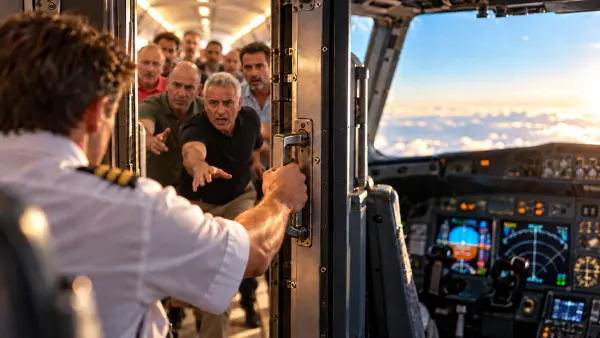
Behind the locked cockpit door, the two pilots were fighting. UAE officials say the co-pilot attacked the captain with the cockpit’s emergency axe, a tool that most passenger planes carry for emergencies. Some sources say the co-pilot allegedly wanted to crash the plane in Israel, but by October 4 the UAE had not announced a motive. The captain, Smit Machchhar, was badly hurt. He later said that he lay on the floor, knew the plane was falling, and saw the door as his last chance. Somehow, he opened it.
Passengers and crew rushed in and overpowered the co-pilot. The plane leveled out, and two other pilots who were on board took the controls. They landed safely in Tabuk, Saudi Arabia. Israel’s prime minister said the captain saved everyone. Experts add that, without his help, getting into a locked cockpit from outside would have been almost impossible.
That door is central to the debate. After the attacks of September 11, 2001, the global aviation body ICAO required stronger cockpit doors. These reinforced doors can resist small-arms fire, and they stay locked during flights. They were built to stop intruders, and they do that job well. But a locked door cannot protect pilots from someone who is already inside. In 2015, a Germanwings co-pilot locked the captain out and flew the plane into the French Alps, and all 150 people on board died.
After the Germanwings crash, many airlines began to use a two-person rule: two crew members must be in the cockpit at all times. Later, some regulators, including Europe’s EASA, made this rule optional. Another question is screening. Passengers go through metal detectors, but crew members may get only random checks. Israel’s prime minister said the co-pilot may not have been required to pass through a metal detector. However, UAE officials say the weapon was the axe that was already in the cockpit.
The biggest questions are about background checks. According to unnamed officials, the co-pilot was an Omani citizen who had been flagged as a security risk and barred from flying in his home country because of concerns about extremist views. Later, flydubai hired him. A Gulf diplomat said he passed standard checks, but they appear to have looked mainly for criminal convictions. Israel says it has agreements to keep pilots from countries without diplomatic relations with Israel off its flights. Oman has no formal ties to Israel, and Israel’s prime minister said there was a loophole. In early October, neither airline had confirmed the reports in public.
What might change? Israel says it will tighten its checks on every flight into the country and check the identities of all pilots. On October 4, the prime minister ordered a review of foreign airlines’ security, and flydubai paused its Tel Aviv flights. Experts suggest heavier screening for crew, more information sharing between countries, and more attention to the insider, someone who works for an organization and knows its weak points. One security expert disagrees: the problem may be that someone ignored the rules, not that the rules are weak. Any new rule will face the same question as the cockpit door: how do you keep danger out without also keeping help out?
Vocabulary
Each word has a frequency score, a rank, and a tag. The score shows how common the word is in modern English: higher means more common, and each full point means roughly ten times more common. The rank is the word’s position on a list of about 321,000 English word forms, from most to least common. The tag shows where you are most likely to meet the word: Current, Formal, Literary, or Dated. The paragraph number shows where the word first appears in the reading. The labels are information, not instructions. Deciding which words are worth your time is up to you. How to read the scores, ranks, and tags.
plunged (verb, past tense): fell very quickly and for a long distance.
Frequency: 3.40 | Rank: 17,122 | Current | Paragraph 1
Translations: 骤降 | 急降下する | 급강하하다 | तेज़ी से गिरना | هوى | стремительно упасть | desplomarse | plonger
- The plane plunged more than 5,000 meters in about two minutes.
- The temperature plunged overnight, and the lake froze.
allegedly (adverb): according to what people say, but without proof that it is true.
Frequency: 4.06 | Rank: 6,456 | Formal | Paragraph 2
Translations: 据称 | 疑惑によると | 주장에 따르면 | कथित तौर पर | يُزعم أنّ | якобы | presuntamente | prétendument
- Some sources say the co-pilot allegedly wanted to crash the plane in Israel.
- The man allegedly took the money, but a court has not decided yet.
motive (noun): the reason why a person does something, especially something bad.
Frequency: 3.94 | Rank: 7,797 | Formal | Paragraph 2
Translations: 动机 | 動機 | 동기 | मकसद | دافع | мотив | motivo | mobile
- By October 4 the UAE had not announced a motive.
- The police could not find a motive for the crime.
overpowered (verb, past tense): took control of a person by being stronger or by being more in number.
Frequency: 3.00 | Rank: 28,918 | Formal | Paragraph 3
Translations: 制伏 | 取り押さえる | 제압하다 | काबू करना | تغلّب على | обезвредить | reducir | maîtriser
- Passengers and crew rushed in and overpowered the co-pilot.
- Three guards overpowered the thief and held him until the police came.
reinforced (adjective): made stronger, often by adding extra material.
Frequency: 3.83 | Rank: 9,165 | Formal | Paragraph 4
Translations: 加固的 | 強化された | 보강된 | प्रबलित | مقوّى | усиленный | reforzado | renforcé
- These reinforced doors can resist small-arms fire.
- The builders made the old bridge safer with a reinforced steel frame.
intruders (noun, plural): people who enter a place without permission, often to cause harm.
Frequency: 3.11 | Rank: 25,070 | Formal | Paragraph 4
Translations: 入侵者 | 侵入者 | 침입자 | घुसपैठिए | متسلّلون | злоумышленники | intrusos | intrus
- The doors were built to stop intruders.
- The alarm rang when intruders entered the shop at night.
optional (adjective): not required, so people can choose to do it or not.
Frequency: 3.91 | Rank: 8,146 | Current | Paragraph 5
Translations: 可选的 | 任意の | 선택적인 | वैकल्पिक | اختياري | необязательный | opcional | facultatif
- Some regulators made the two-person rule optional.
- The class trip is optional, so you can stay at home if you want.
screening (noun): the checking of people and bags for dangerous items.
Frequency: 4.15 | Rank: 5,595 | Current | Paragraph 5
Translations: 安检 | 保安検査 | 보안 검색 | सुरक्षा जाँच | فحص أمني | досмотр | control de seguridad | contrôle de sécurité
- Passengers go through screening, but the rules for crew can be different.
- Airport screening takes about ten minutes on a quiet day.
flagged (verb, past participle): marked as a possible problem or danger.
Frequency: 3.31 | Rank: 19,336 | Current | Paragraph 6
Translations: 标记 | 要注意とされた | 표시된 | चिह्नित | تمّ رصده | помеченный | señalado | signalé
- The co-pilot had been flagged as a security risk.
- The bank flagged the payment as a possible fraud.
barred (verb, past participle): not allowed to do something because of a rule or an order.
Frequency: 3.71 | Rank: 11,015 | Formal | Paragraph 6
Translations: 被禁止 | 禁じられた | 금지당한 | प्रतिबंधित | محظور | отстранённый | vetado | interdit
- The co-pilot had been barred from flying in his home country.
- He was barred from the club for fighting.
convictions (noun, plural): official decisions in a court that a person is guilty of a crime.
Frequency: 3.71 | Rank: 11,015 | Formal | Paragraph 6
Translations: 定罪记录 | 有罪判決 | 유죄 판결 | दोषसिद्धि | إدانات | судимости | condenas | condamnations
- The checks appear to have looked mainly for criminal convictions.
- The man had two convictions for stealing cars.
diplomatic relations (noun phrase): official contact between the governments of two countries.
Frequency: no score (phrase) | Formal | Paragraph 6
Translations: 外交关系 | 外交関係 | 외교 관계 | राजनयिक संबंध | علاقات دبلوماسية | дипломатические отношения | relaciones diplomáticas | relations diplomatiques
- Oman has no formal diplomatic relations with Israel.
- The two countries ended their diplomatic relations after the dispute.
loophole (noun): a gap in a rule or system that lets people avoid it.
Frequency: 3.24 | Rank: 21,209 | Formal | Paragraph 6
Translations: 漏洞 | 抜け穴 | 허점 | खामी | ثغرة | лазейка | laguna | faille
- Israel’s prime minister said there was a loophole.
- The company used a loophole in the law to pay less tax.
tighten (verb): to make rules or checks stricter.
Frequency: 3.51 | Rank: 14,731 | Current | Paragraph 7
Translations: 加强 | 厳しくする | 강화하다 | कड़ा करना | يشدّد | ужесточить | endurecer | renforcer
- Israel says it will tighten its checks on every flight into the country.
- The school decided to tighten the rules on phones.
insider (noun): a person who is part of a group or organization and knows its secrets.
Frequency: 3.77 | Rank: 10,028 | Current | Paragraph 7
Translations: 内部人员 | 内部関係者 | 내부자 | अंदरूनी व्यक्ति | شخص من الداخل | свой человек внутри | persona de dentro | initié
- Experts want more attention for the insider.
- An insider told the newspaper about the company’s secret plan.
Activity Page
Open the activity page in a new tab
Speed Challenge
Answer 12 questions against the clock. Every wrong answer adds 5 seconds, and the lowest score wins. Open the speed challenge in a new tab.
Shadow Reading and Typing: Checking the Checks
This short text uses many of the words from this lesson. Use it for shadow reading (reading aloud along with a model) and for typing practice.
I fly several times a year, and I never thought much about security. The screening line is slow, and I used to see it as a small price to pay. After I read about the flydubai attack, I started to notice the details. Why are some checks random? Why are some rules optional?
My first thought was about the cockpit door. It is reinforced so that intruders cannot get in, and I felt safer knowing that. But the same door can also keep helpers out. That idea stayed with me for days. A rule that protects us from one danger can leave a gap somewhere else.
Then I thought about people. A guard looks at my bag, but who looks at the people who fly the plane? An insider knows the weak points, and an airline cannot read minds. When a pilot is flagged as a risk, the warning has to reach the next employer. If it does not, a loophole stays open.
I do not want airports to become places of fear. Still, I think governments should tighten some rules, and they should do it with care. A person who is allegedly dangerous should be checked, but a person with no convictions should not be treated like a criminal. Next time, I will wait patiently in the line.
How to practice
- Read the text silently once and check any words you are unsure of.
- Read it aloud slowly, one sentence at a time. On the typing page, the Listen button reads each line with your device’s voice, so you can listen first and then repeat.
- Shadow: read aloud again at a natural speed, trying to keep a steady rhythm without stopping.
- Record yourself, listen back, and note one sentence to practice again.
- Type it on the typing page below and check your speed and accuracy.
Open the typing practice in a new tab
Comprehension Questions
- Where was flydubai Flight FZ1073 going, and what happened about two hours after takeoff?
- What do UAE officials say the co-pilot used to attack the captain?
- What did the captain do even though he was badly hurt, and why was it so important?
- Who stopped the attack, and who landed the plane?
- Why did the world’s aviation body require stronger cockpit doors after September 11, 2001?
- How did the Germanwings case in 2015 show a problem with locked cockpit doors?
- The reading raises two questions about rules: one about screening and one about background checks. Explain each one in your own words.
- What changes might happen after the attack? Name two from the reading.
- Should crew members go through the same screening as passengers? Give two reasons.
IELTS-Style Questions
- True, False, or Not Given: “Flydubai has confirmed that the co-pilot was flagged as a risk before it hired him.” Explain your answer using evidence from the reading.
- Yes, No, or Not Given: “The writer believes that locked cockpit doors were a mistake.” Explain your answer using evidence from the reading.
- Author’s purpose: Why does the writer end with a question about keeping danger out without keeping help out? Is the aim to give a final answer, to show a problem that is still hard to solve, or to blame one organization?
AI Discussion Prompt
I just read an article about flydubai Flight FZ1073 and the attack in the cockpit on September 30, 2026. It covered what happened on the flight, how the captain opened the door, how cockpit door rules and the two-person rule work, questions about crew screening and background checks, and what might change. I am an English learner at about B1 level. Please ask me one question at a time, starting with how I feel about flying. Use simple language, respond to my ideas first, then briefly correct any language errors, and ask follow-up questions that make me explain my reasons.
AI Vocabulary Prompt
I want to practice vocabulary from an article about cockpit security. Please quiz me on the following words one at a time, using a mix of question types: multiple choice, true/false, and sentence completion. Give me feedback after each answer before moving on, and bring back the words I miss later. Here are the words: plunged, allegedly, motive, overpowered, reinforced, intruders, optional, screening, flagged, barred, convictions, diplomatic relations, loophole, tighten, insider.
Discussion Questions
- Do you enjoy flying? What do you like or dislike about being on a plane?
- What is the longest flight you have taken? What did you do to pass the time?
- Do airport security checks bother you, or do they make you feel safer?
- Imagine you were a passenger on flight FZ1073. What do you think you would do?
- Passengers and crew helped to stop the attack. What qualities do people need in an emergency?
- Some people stay calm in a crisis, and others do not. What do you think makes the difference?
- After 2001, many countries made cockpit doors stronger, and that solved one problem but created another. Can you think of another rule that did something similar?
- In many places, pilots are not screened in exactly the same way as passengers. Should they be? Why or why not?
- A two-person rule can make flights a little safer, but it also makes work harder for airlines. How would you decide whether it is worth it?
- An airline wants to check a pilot’s background before hiring. What should it be allowed to ask, and what should stay private?
- A warning about a person in one country does not always reach other countries. What kinds of information should be shared across borders, and who should decide?
- In the days after a news event like this one, officials and experts often disagree. Whom do you trust for information while the facts are still coming out, and why?
- One expert in the reading says the rules may be fine and that someone may have ignored them. Another says the rules need to change. How would you test who is right?
- How safe is safe enough? Should a society accept a very small risk to keep travel cheap and easy?
Language Focus: Past Simple and Past Continuous
What it is: Use the past simple for finished actions, often one after another: the plane plunged, passengers rushed in. Use the past continuous (was or were + verb with -ing) for an action that was in progress at a moment in the past. It often gives the background to another event.
Why writers use it: News stories use both tenses to tell what happened. The past continuous sets the scene, and the past simple moves the story forward.
Examples from the reading:
- “The plane was flying at about 10,000 meters when it plunged more than 5,000 meters in about two minutes…”
- “Behind the locked cockpit door, the two pilots were fighting.”
- “…knew the plane was falling, and saw the door as his last chance.”
- “Passengers and crew rushed in and overpowered the co-pilot.”
Practice task: Complete the sentence with the past simple or the past continuous: Last night I (watch) the news when my phone (ring).
(Example answer: “Last night I was watching the news when my phone rang.”)
Online Resources
- In-flight attack on FlyDubai pilot puts aviation security measures under scrutiny (ABC News, Associated Press). A long news report on Israel’s security rules and why door, crew screening, and vetting rules are being questioned. It supports paragraphs 3 to 7.
- Who is the mystery co-pilot behind the Flydubai attack? (Al Jazeera). A timeline of the flight, from takeoff to landing in Tabuk, and what the UAE has said about the axe attack. It supports paragraphs 1 to 3.
- How can aircraft cockpits be protected from threats from pilots or passengers? (The National). An explainer on cockpit doors, the Germanwings crash, and the two-person rule. It supports paragraphs 4 and 5.
- AP report: UAE had shared details about FlyDubai flight with Israel, including pilots’ names and nationalities (PBS News, Associated Press). A report on who checked the flight’s crew and passengers, and on the review that Israel’s prime minister ordered. It supports paragraphs 6 and 7.
- Airline safety expert explains how cockpits have become more secure, but only from outside threats (The Conversation). A short article by an aviation professor on crew screening and hardened cockpit doors, written for general readers.