
Level: B2
Reading | Vocabulary | Activities | Speed Challenge | Shadow Reading and Typing | Questions | AI Prompts | Discussion | Language Focus | Resources
Printable: Student handout (PDF) | Teacher’s key (PDF)
Reading
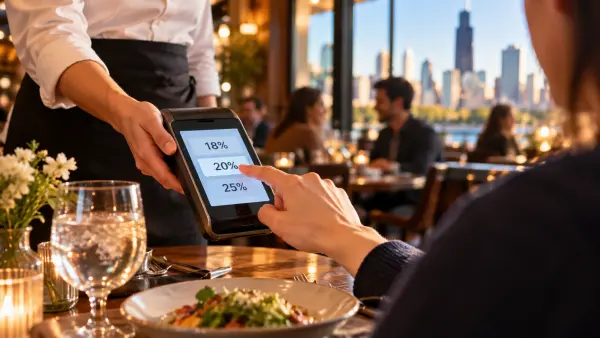
You finish dinner at a restaurant in Chicago. The card reader turns toward you and prompts you to choose 18, 20, or 25 percent, while the server stands a few steps away. Now picture the same moment in Tokyo. If you try to hand over extra money there, the staff will probably look surprised, because tipping is not expected. Neither country is being strange. Each follows its own etiquette, and the gap between them is wider than many travelers realize.
In the United States, leaving a tip is customary in restaurants, and surveys show that most diners do it. In a large national survey in 2023, about nine in ten adults who eat at sit-down restaurants said they always or often leave a gratuity. Yet only about one in three adults said it was easy to know whether to tip for different services, and about seven in ten said tipping is expected in more places than it was five years earlier. Requests now appear in cafes, on delivery apps, and on some self-service screens, so it is not surprising that many people find the rules bewildering.
Part of the reason is legal. Under federal law, employers can pay many tipped workers a cash wage of only $2.13 an hour, a figure that has not changed since 1991. Tips are meant to supplement that wage. If a worker’s tips do not bring the total up to the federal minimum of $7.25 an hour, the employer must cover the shortfall. Even so, a server’s earnings can depend heavily on customers, so the arrangement asks diners to pay part of a wage that the menu does not show. A handful of states, including California and Washington, require employers to pay tipped staff the full minimum wage, and tips there are simply extra.
Elsewhere the logic is different. In Australia, tipped workers have no lower wage rate, so a tip is a bonus, not a necessity. In Japan, service charges are often built into prices, and good service is seen as part of the job, so extra money may come across as awkward or even insulting. In Germany, tipping is normal but modest: diners usually round up the bill or add a few percent, and the usual advice is to say the total when you pay. In Italy, the cover charge called coperto is not a tip for the server. Some restaurants also add a mandatory service charge. If the bill already includes one, you may not need to add more, so it is worth reading the bill carefully.
Tipping did not begin in America. Historians trace it to England, where wealthy guests in the 1500s gave small payments called vails to the servants of their hosts, and where coffeehouse customers later tipped for better service. When the habit spread in the United States after the Civil War, many Americans disliked it. They thought it was demeaning to workers and wrong for a country of equals. One writer in 1916 argued that tipping threatened American democracy. Between 1909 and 1915, six states tried to outlaw it, but the laws were largely ignored, and all of them had been repealed by the 1920s.
Does tipping at least reward good service? The evidence suggests only partly. Research by Michael Lynn, a professor at Cornell University, has found that tip size is only weakly related to how customers rate their service. Small things, such as a server crouching next to the table, seem to raise tips more than you might expect. If the amount can depend on such arbitrary details, critics argue, tipping is a weak incentive to work well. These findings come from restaurant studies, and they may not hold in every country or every kind of job.
Today the debate is moving again. In the 2023 survey, four in ten American adults opposed businesses suggesting tip amounts on screens, and about seven in ten opposed automatic charges. That backlash may mean that many customers want to know the full price in advance, but the survey did not ask why. Would you accept a higher menu price in exchange for no tipping, or would you miss the choice?
Vocabulary
Each word has a frequency score, a rank, and a tag. The score shows how common the word is in modern English: higher means more common, and each full point means roughly ten times more common. The rank is the word’s position on a list of about 321,000 English word forms, from most to least common. The tag shows where you are most likely to meet the word: Current, Formal, Literary, or Dated. The paragraph number shows where the word first appears in the reading. The labels are information, not instructions. Deciding which words are worth your time is up to you. How to read the scores, ranks, and tags.
prompts (verb, third person singular): encourages or reminds someone to take an action, often by showing a message or a question.
Frequency: 3.34 | Rank: 18,537 | Current | Paragraph 1
Translations: 提示 | 促す | 유도하다 | प्रेरित करना | يحثّ | побуждать | incitar | inciter
- The card reader prompts customers to choose a tip.
- A message on my phone prompts me to update the app.
etiquette (noun): the accepted rules of polite behavior in a society, a group, or a situation.
Frequency: 3.40 | Rank: 17,122 | Formal | Paragraph 1
Translations: 礼仪 | エチケット | 예절 | शिष्टाचार | آداب السلوك | этикет | etiqueta | savoir-vivre
- Each country follows its own etiquette about tipping.
- Business etiquette includes arriving on time for meetings.
customary (adjective): usual or traditional in a particular place or situation.
Frequency: 3.53 | Rank: 14,307 | Formal | Paragraph 2
Translations: 惯例的 | 慣習的な | 관례적인 | प्रचलित | متعارف عليه | принятый | habitual | d’usage
- In the United States, leaving a tip is customary in restaurants.
- It is customary to take off your shoes in many homes.
gratuity (noun): a small extra amount of money given to a worker for a service, also called a tip.
Frequency: 2.64 | Rank: 44,767 | Formal | Paragraph 2
Translations: 小费 | チップ | 팁 | बख़्शीश | إكرامية | чаевые | propina | pourboire
- Most diners in the survey said they leave a gratuity at a sit-down restaurant.
- The hotel staff thanked us for the gratuity.
bewildering (adjective): so confusing that you do not know what to think or do.
Frequency: 2.84 | Rank: 35,320 | Current | Paragraph 2
Translations: 令人困惑的 | 戸惑わせる | 당혹스러운 | भ्रमित करने वाला | مُحيّر | сбивающий с толку | desconcertante | déroutant
- Many people find the tipping rules bewildering.
- The bus map was bewildering, so we asked a driver.
supplement (verb): to add something to what already exists, usually to make it larger or better.
Frequency: 4.03 | Rank: 6,784 | Current | Paragraph 3
Translations: 补充 | 補う | 보충하다 | पूरक होना | يُكمِّل | дополнять | complementar | compléter
- Tips are meant to supplement a server’s wage.
- Many students supplement their income with weekend jobs.
shortfall (noun): the amount by which something is less than what is needed or expected.
Frequency: 3.02 | Rank: 28,214 | Formal | Paragraph 3
Translations: 差额 | 不足額 | 부족분 | कमी | عجز | нехватка | déficit | déficit
- The employer must cover the shortfall if tips are too low.
- The charity had a shortfall of two thousand dollars.
come across as (phrasal verb): to give other people a particular impression of you or of what you do.
Frequency: no score (phrase) | Current | Paragraph 4
Translations: 给人…的印象 | という印象を与える | ~로 보이다 | …जैसा प्रतीत होना | يبدو كـ | производить впечатление | parecer | paraître
- In Japan, extra money may come across as awkward.
- A short email can come across as rude.
round up (phrasal verb): to increase a number or an amount to the next convenient whole number.
Frequency: no score (phrase) | Current | Paragraph 4
Translations: 凑整 | 切り上げる | 올림하다 | पूर्णांक में बढ़ाना | يقرّب إلى الأعلى | округлять в большую сторону | redondear al alza | arrondir au supérieur
- In Germany, diners usually round up the bill.
- Please round up the total to the nearest dollar.
mandatory (adjective): required by a rule or a law, so that you have no choice.
Frequency: 4.13 | Rank: 5,778 | Formal | Paragraph 4
Translations: 强制性的 | 義務的な | 의무적인 | अनिवार्य | إلزامي | обязательный | obligatorio | obligatoire
- Some restaurants add a mandatory service charge.
- Seat belts are mandatory in most countries.
demeaning (adjective): making a person feel that they are not respected or are less important than others.
Frequency: 2.93 | Rank: 31,549 | Formal | Paragraph 5
Translations: 有损尊严的 | 品位を下げる | 굴욕적인 | अपमानजनक | مُهين | унизительный | degradante | dégradant
- Many Americans thought tipping was demeaning to workers.
- She quit because the way her boss spoke to staff was demeaning.
outlaw (verb): to make something illegal by passing a law against it.
Frequency: 3.51 | Rank: 14,731 | Formal | Paragraph 5
Translations: 取缔 | 違法とする | 금지하다 | प्रतिबंधित करना | يحظر | запрещать | prohibir | interdire
- Six states tried to outlaw tipping in the early 1900s.
- The city plans to outlaw plastic bags next year.
arbitrary (adjective): decided by chance or by personal choice, not by a clear reason or rule.
Frequency: 3.85 | Rank: 8,918 | Formal | Paragraph 6
Translations: 随意的 | 恣意的な | 임의적인 | मनमाना | اعتباطي | произвольный | arbitrario | arbitraire
- A tip can depend on arbitrary details, such as how a server stands.
- The rule seemed arbitrary because nobody could explain it.
incentive (noun): a reward or reason that makes a person want to do something or work harder.
Frequency: 3.97 | Rank: 7,445 | Current | Paragraph 6
Translations: 激励 | インセンティブ | 유인책 | प्रोत्साहन | حافز | стимул | incentivo | incitation
- Critics say tipping is a weak incentive to work well.
- Lower prices give customers an incentive to buy early.
backlash (noun): a strong negative reaction from many people against a new idea or a change.
Frequency: 3.66 | Rank: 11,870 | Current | Paragraph 7
Translations: 强烈反对 | 反発 | 반발 | विरोध | ردة فعل عنيفة | негативная реакция | rechazo | réaction hostile
- Suggested tip screens have caused a backlash among some customers.
- The new fee caused a public backlash, and the company withdrew it.
Activity Page
Open the activity page in a new tab
Speed Challenge
Answer 12 questions against the clock. Every wrong answer adds 5 seconds, and the lowest score wins. Open the speed challenge in a new tab.
Shadow Reading and Typing: My Lesson in Tokyo
This short text uses many of the words from this lesson. Use it for shadow reading (reading aloud along with a model) and for typing practice.
I learned the rules of tipping the hard way. On my first night in Tokyo, I left coins on the table, as I always do at home. The server looked surprised, and I realized I had broken a rule of local etiquette. Tipping is not customary there, so my gratuity came across as awkward.
Back at the hotel, I thought about my own country. At home, many servers are paid a low cash wage, and tips supplement it. If the tips are too small, the employer must cover the shortfall. I had never thought about that before.
A week later, in Berlin, I tried a different approach. When the bill came, I decided to round up and said the total aloud. The server nodded, and the moment felt easy. I still find mandatory charges confusing, so I now read every bill carefully.
At the airport, I thought about the screen that prompts me to tip at home. It offers three buttons, and I always feel a little pressure. Perhaps the amount is arbitrary, but the pressure is real. Some of my friends feel a backlash against it, and I understand. Next time, I will ask what the local custom is before I pay.
How to practice
- Read the text silently once and check any words you are unsure of.
- Read it aloud slowly, one sentence at a time. On the typing page, the Listen button reads each line with your device’s voice, so you can listen first and then repeat.
- Shadow: read aloud again at a natural speed, trying to keep a steady rhythm without stopping.
- Record yourself, listen back, and note one sentence to practice again.
- Type it on the typing page below and check your speed and accuracy.
Open the typing practice in a new tab
Comprehension Questions
- What contrast does the opening paragraph draw between a restaurant in Chicago and one in Tokyo?
- What do the survey results in paragraph 2 suggest about how Americans feel about tipping rules?
- Why does the federal tipped wage help to explain why tipping matters so much in the United States?
- What must an employer do in the United States if a worker’s tips and cash wage add up to less than the federal minimum?
- Give two reasons from the reading why a tip may come across as awkward in Japan.
- What is the difference between a mandatory service charge and a tip? Why does the writer advise reading the bill carefully?
- Why did many Americans dislike tipping after the Civil War, and what happened to the laws against it?
- What does the research described in paragraph 6 suggest about tipping and service quality? Why does the writer add a caution at the end?
- In paragraph 7, what might the opposition to suggested tips and automatic charges mean, and what does the writer admit the survey cannot show?
IELTS-Style Questions
- True, False, or Not Given: “Servers in Japan earn higher wages than servers in the United States.” Explain your answer using evidence from the reading.
- Yes, No, or Not Given: “The writer believes that tipping is always a fair reward for good service.” Explain your answer using evidence from the reading.
- Author’s purpose: Why does the writer open the reading with a scene at a card reader in Chicago and then move to Tokyo? What does this add?
AI Discussion Prompt
I just read an article about tipping around the world. It covered the card readers that prompt Americans to tip, a 2023 survey of American attitudes, the $2.13 federal tipped wage, customs in Australia, Japan, Germany, and Italy, the history of tipping and the early laws against it, research on tips and service quality, and the backlash against suggested tips. I am an English learner at about B2 level. Please ask me one question at a time, starting with how I decide whether to leave a tip. Respond to my ideas first, then briefly correct any language errors, and ask follow-up questions that make me explain my reasons.
AI Vocabulary Prompt
I want to practice vocabulary from an article about tipping around the world. Please quiz me on the following words one at a time, using a mix of question types: multiple choice, true/false, and sentence completion. Give me feedback after each answer before moving on, and bring back the words I miss later. Here are the words: prompts, etiquette, customary, gratuity, bewildering, supplement, shortfall, come across as, round up, mandatory, demeaning, outlaw, arbitrary, incentive, backlash.
Discussion Questions
- When did you last leave a tip, and how did you decide how much to give?
- Do you ever feel pressure when a screen or a server asks you to tip? Describe a time when this happened.
- What are the tipping customs in your country for restaurants, taxis, and hotels? If tipping is rare, why do you think that is?
- Have you ever been confused about tipping while traveling? What happened, and what did you learn?
- Which workers do you think deserve a tip, even if tipping is not customary for their job?
- Is it better to round up the bill, add a percentage, or leave nothing? Explain your choice.
- The reading says extra money may come across as awkward in Japan. What gifts or gestures from your culture might be received differently abroad?
- Would you accept higher menu prices if restaurants stopped asking for tips? Why or why not?
- Should most of a worker’s income come from the employer or from customers? Explain your view.
- Many Americans once thought tipping was demeaning to workers. Can receiving a tip feel demeaning today? Why or why not?
- The research in the reading suggests that tip size is only weakly related to service quality. If that is true, what should tips be for?
- Some countries add service charges instead of asking for tips. What are the advantages and disadvantages for customers, workers, and owners?
- Can good service be rewarded fairly with money, or are there better ways to show appreciation? Who should decide?
- How might tipping customs change in the next twenty years as more people pay by phone or card?
Language Focus: Zero and First Conditionals
What it is: A conditional sentence has an if clause and a main clause. In the zero conditional, the if clause uses the present simple and the main clause states a general rule or a fact that is always true, often with must, can, or may. In the first conditional, if plus the present simple is followed by will, may, or another future form, to talk about a real possibility.
Why writers use it: Writers use real conditionals to explain rules, customs, and advice. The reading uses them to describe how tipping works and what a traveler can do. Do not use will in the if clause: say if you try, not if you will try.
Examples from the reading:
- “If you try to hand over extra money there, the staff will probably look surprised…”
- “If a worker’s tips do not bring the total up to the federal minimum of $7.25 an hour, the employer must cover the shortfall.”
- “If the bill already includes one, you may not need to add more…”
Practice task: Write two sentences about tipping or gift customs in your own country: one zero conditional (a general rule) and one first conditional (a real possibility for a visitor).
(Example answer: “Zero conditional: If a restaurant bill includes a service charge, most people do not leave an extra tip. First conditional: If you visit my country, you will see that people usually say thank you in person.”)
Online Resources
- Tipping Culture in America: Public Sees a Changed Landscape (Pew Research Center). The 2023 survey behind the figures in paragraphs 2 and 7, with charts on who tips, where, and how people feel about suggested tips.
- Tipping: From Scourge of Democracy to American Ritual (Federal Reserve Bank of Richmond). A readable history of tipping, from English servants in the 1500s to the state laws against it described in paragraph 5.
- Fact Sheet #15: Tipped Employees Under the Fair Labor Standards Act (US Department of Labor). The official rules on the $2.13 cash wage and the tip credit explained in paragraph 3.
- Tipping in Japan (Japan National Tourism Organization). Official travel advice on why tipping is not common in Japan, and what to do if you still want to give money (paragraph 4).
- Studying the attitudes of gratitude that affect gratuities (Cornell Chronicle). A profile of Michael Lynn, the tipping researcher mentioned in paragraph 6, and what his studies found about tips and service.