
Level: C1
Reading | Vocabulary | Activities | Speed Challenge | Shadow Reading and Typing | Questions | AI Prompts | Discussion | Language Focus | Resources
Printable: Student handout (PDF) | Teacher’s key (PDF)
Reading
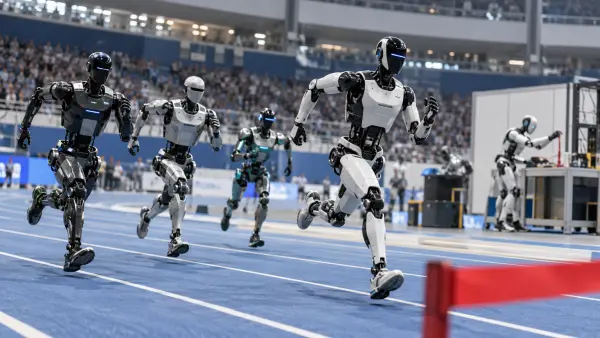
The second World Humanoid Robot Games, often nicknamed the Robot Olympics, took place in Beijing from 22 to 26 August 2026 at the National Speed Skating Oval. Organizers reported 666 teams and 2,056 robots, compared with 280 teams and about 500 robots at the first edition in 2025, and the program nearly doubled from 26 to 51 events. Thirty were sporting contests, such as athletics and football, and 21 were scenario-based events designed to test work in factories, hotels, homes, and shops. The Games are also a showcase for the host country’s robotics industry and a public benchmark for researchers and investors, and the organizers openly describe them as a way to speed the robots’ integration into human life.
The most dramatic change was speed. The winning 100 meters in 2025 took 21.50 seconds. In 2026, a robot called Tiangong Ultra, developed by the Beijing Humanoid Robot Innovation Center, ran 9.39 seconds on the opening day, 8.86 in a semifinal, and 8.64 in the large-robot final, all faster than Usain Bolt’s human record of 9.58. According to Live Science, it also won the 400 meters in 38.15 seconds, against a human record of 43.03, and the 1,500 meters in 2 minutes 21.6 seconds, well inside the human record. Yet news agencies noted that these results are not comparable with human athletics, because the rules, robot classes, and conditions differ. The spectacle is real, but it is a claim about machines, not a race against people.
Speed is only one measure. The scenario events asked robots to sort books, serve food and drinks, respond to fires, and charge electric vehicles, and eight of them focused on dexterity: opening lids, assembling power tools, connecting cables, and picking up beans with tweezers. Reuters framed the contrast in its headline, asking whether robots that can outrun humans can also plug in a cable. The answer at these Games was mixed. Hand skills appeared to lag behind running, which suggests that fine manipulation is the bottleneck for useful work.
The rules show which abilities have matured. Running races, football, table tennis, and dance required autonomy, meaning that no human controlled the robot during the event. Weightlifting, kickboxing, and jumping still allowed remote control, and in scenario tasks, remote operation earned only half the points. This distinction matters, because a robot that is remotely controlled demonstrates mainly its hardware, not its ability to act alone. It also means that results from different events should not be compared directly, since the rules allowed different levels of human help.
Falls and their consequences remained the most visible problem. Robots still stumble: at the first Games in 2025, football players fell over en masse, and this year the fastest machines were still hard to stop. The robot that set the 8.64-second record crashed into the padded barrier after finishing, and almost all the runners in that final were carried away on stretchers. Dennis Hong, a robotics professor at the University of California, Los Angeles, told the Associated Press that the important questions are whether robots can move and stop safely, recognize unexpected obstacles, and recover from mistakes. Jonathan Hurst of Oregon State University told the agency that real progress would be measured when humanoids work autonomously for hours and generate economic value. Both comments point to robust behavior, not peak performance.
Outside the arena, the picture is more modest. Companies now deploy humanoids in factories and warehouses, and the strongest tangible results are in narrow, structured tasks. For the home, 1X began taking orders for its NEO robot in October 2025, at $20,000 or $499 a month, and plans its first deliveries to US customers in 2026. The company itself says that for tasks the robot has not yet learned, its staff can guide it through remote supervision. Unitree listed on the Shanghai market in August 2026, yet its net profit fell sharply in the first quarter as spending rose, according to Caixin. More skeptical analysts, such as those at Technology.org, add that widely repeated claims of tens of thousands of deployed units do not survive a check against company filings.
Three things therefore seem likely, although none is certain. First, robots will probably enter workplaces before homes, because factories and warehouses are structured and easier to control. Second, geopolitics will shape the market: China dominates the volume of industrial robots, with 54 percent of global installations in 2024 according to the International Federation of Robotics, and in July 2026 the US Federal Communications Commission blocked approval of new foreign-made humanoid models. Third, the industry will need to separate hype from evidence. Organizers say that the 2027 Games will lean further toward practical tasks, which is a sensible test of whether the promise of household robots that companies envision can be met.
Vocabulary
Each word has a frequency score, a rank, and a tag. The score shows how common the word is in modern English: higher means more common, and each full point means roughly ten times more common. The rank is the word’s position on a list of about 321,000 English word forms, from most to least common. The tag shows where you are most likely to meet the word: Current, Formal, Literary, or Dated. The paragraph number shows where the word first appears in the reading. The labels are information, not instructions. Deciding which words are worth your time is up to you. How to read the scores, ranks, and tags.
showcase (noun): an event or display that presents the best of something to the public.
Frequency: 3.92 | Rank: 8,036 | Current | Paragraph 1
Translations: 展示 | ショーケース | 쇼케이스 | प्रदर्शन | عرض | витрина | escaparate | vitrine
- The Games are a showcase for the host country’s robotics industry.
- The festival is a showcase for young musicians.
benchmark (noun): a standard or point of reference against which other things are compared.
Frequency: 3.60 | Rank: 12,940 | Formal | Paragraph 1
Translations: 基准 | 基準 | 기준 | मानक | معيار | эталон | referencia | référence
- The Games provide a public benchmark for researchers and investors.
- The company uses last year’s sales as a benchmark.
comparable (adjective): similar enough in size, type, or quality to be compared fairly.
Frequency: 4.08 | Rank: 6,230 | Formal | Paragraph 2
Translations: 可比的 | 比較可能な | 비교할 수 있는 | तुलनीय | قابل للمقارنة | сопоставимый | comparable | comparable
- These results are not comparable with human athletics.
- The two cities are comparable in size.
spectacle (noun): an impressive or unusual public display or event.
Frequency: 3.61 | Rank: 12,764 | Formal | Paragraph 2
Translations: 壮观场面 | 見世物 | 볼거리 | तमाशा | مشهد | зрелище | espectáculo | spectacle
- The spectacle is real, but it is a claim about machines.
- The fireworks were a spectacle that drew thousands.
dexterity (noun): skill and precision in using the hands.
Frequency: 3.07 | Rank: 26,420 | Formal | Paragraph 3
Translations: 灵巧 | 器用さ | 손재주 | कुशलता | براعة يدوية | ловкость | destreza | dextérité
- Eight events focused on dexterity.
- Surgeons need great manual dexterity.
bottleneck (noun): a point where progress or flow is slowed because capacity is limited.
Frequency: 2.97 | Rank: 30,017 | Formal | Paragraph 3
Translations: 瓶颈 | ボトルネック | 병목 | बाधा | عنق الزجاجة | узкое место | cuello de botella | goulet d’étranglement
- Fine manipulation may be the bottleneck for useful work.
- The narrow bridge is a bottleneck for traffic.
autonomy (noun): the ability to act or make decisions without control from others.
Frequency: 3.86 | Rank: 8,784 | Formal | Paragraph 4
Translations: 自主性 | 自律性 | 자율성 | स्वायत्तता | استقلالية | автономность | autonomía | autonomie
- Running races, football, and dance required autonomy.
- Teenagers often want more autonomy from their parents.
stumble (verb): to trip or move unsteadily and nearly fall; also to make a mistake.
Frequency: 3.42 | Rank: 16,687 | Current | Paragraph 5
Translations: 踉跄 | つまずく | 비틀거리다 | लड़खड़ाना | يتعثر | спотыкаться | tropezar | trébucher
- Robots still stumble at high speed.
- She stumbled on the stairs but did not fall.
robust (adjective): strong, reliable, and able to keep working under difficult conditions.
Frequency: 3.94 | Rank: 7,797 | Formal | Paragraph 5
Translations: 稳健 | 堅牢な | 견고한 | मज़बूत | متين | надёжный | robusto | robuste
- Both comments point to robust behavior, not peak performance.
- The system must be robust enough to work all day.
deploy (verb): to put people or equipment into active use in a particular place.
Frequency: 3.70 | Rank: 11,198 | Formal | Paragraph 6
Translations: 部署 | 配備する | 배치하다 | तैनात करना | ينشر | развёртывать | desplegar | déployer
- Some companies deploy humanoids in factories and warehouses.
- The city will deploy extra police at the festival.
tangible (adjective): real and clear enough to be seen, felt, or measured.
Frequency: 3.66 | Rank: 11,870 | Formal | Paragraph 6
Translations: 切实的 | 具体的な | 실질적인 | मूर्त | ملموس | ощутимый | tangible | tangible
- The strongest tangible results are in narrow, structured tasks.
- The project has produced tangible benefits for the town.
supervision (noun): the act of watching and directing people or activities to make sure they are done correctly.
Frequency: 3.94 | Rank: 7,797 | Formal | Paragraph 6
Translations: 监督 | 監督 | 감독 | पर्यवेक्षण | إشراف | надзор | supervisión | supervision
- For unfamiliar tasks, its staff can guide it through remote supervision.
- The children played under adult supervision.
skeptical (adjective): doubtful about whether a claim or idea is true or will work.
Frequency: 3.68 | Rank: 11,541 | Formal | Paragraph 6
Translations: 怀疑的 | 懐疑的な | 회의적인 | संशयी | متشكك | скептический | escéptico | sceptique
- Skeptical analysts question the company’s figures.
- I am skeptical about claims that sound too good to be true.
hype (noun): exaggerated publicity or promotion that promises more than can be delivered.
Frequency: 4.03 | Rank: 6,784 | Current | Paragraph 7
Translations: 炒作 | 誇大宣伝 | 과대광고 | प्रचार | ضجة إعلامية | шумиха | publicidad exagerada | battage
- The industry will need to separate hype from evidence.
- The new phone lived up to the hype.
envision (verb): to imagine something as a future possibility.
Frequency: 3.17 | Rank: 23,253 | Formal | Paragraph 7
Translations: 设想 | 思い描く | 구상하다 | कल्पना करना | يتصوّر | представлять | vislumbrar | envisager
- The household robots that companies envision may take years.
- She envisions a school where every child can play outside.
Activity Page
Open the activity page in a new tab
Speed Challenge
Answer 12 questions against the clock. Every wrong answer adds 5 seconds, and the lowest score wins. Open the speed challenge in a new tab.
Shadow Reading and Typing: A Day at the Robot Games
This short text uses many of the words from this lesson. Use it for shadow reading (reading aloud along with a model) and for typing practice.
When my professor offered me a spare ticket to the Robot Games in Beijing, I accepted at once. I expected a showcase of polished machines, and in some ways that is exactly what I saw. The arena was loud, and the event felt closer to a concert than a research benchmark.
The 100 meters was the great spectacle of the day. The winning robot crossed the line faster than any human sprinter has ever run, and the crowd went wild. Yet my professor reminded me that the times are not truly comparable, because the rules differ from human athletics. Moments later, the winner crashed into the padded barrier, and I saw how hard it still is for these machines to stop.
The events that impressed me most were the quiet ones. Watching a robot pick up beans with tweezers, I finally understood why engineers call dexterity the real bottleneck. Some robots seemed to stumble as they carried trays of drinks. The runners had full autonomy. In other events, humans could still help from a distance, so I wondered what I was really watching.
On the train home, I tried to separate the hype from what I had actually seen. Companies envision robots in every home. The tangible progress, however, seems to be in factories and warehouses, where tasks are structured. Before anyone could deploy one in my apartment, I would want a robust machine that works for hours without human supervision. For now, I remain skeptical, but curious.
How to practice
- Read the text silently once and check any words you are unsure of.
- Read it aloud slowly, one sentence at a time. On the typing page, the Listen button reads each line with your device’s voice, so you can listen first and then repeat.
- Shadow: read aloud again at a natural speed, trying to keep a steady rhythm without stopping.
- Record yourself, listen back, and note one sentence to practice again.
- Type it on the typing page below and check your speed and accuracy.
Open the typing practice in a new tab
Comprehension Questions
- How did the scale and program of the 2026 Games differ from 2025? What two kinds of event are there?
- How did the 100-meter time change, and why are the results not comparable with human athletics?
- What did the scenario events test, and what does the reading suggest about running and hand skills?
- How do the rules treat autonomy, and why does the difference from remote control matter?
- What problems did the falls reveal? Summarize the comments of Dennis Hong and Jonathan Hurst.
- How does the sixth paragraph describe humanoids outside the arena? Give two examples.
- State the three likely trends in the last paragraph and the reasoning behind each.
- Why does the writer refer to “hype”? How could the 2027 Games help separate hype from evidence?
- Evaluate the sources (news agencies, experts, companies, blogs). Which claims are best supported?
IELTS-Style Questions
- True, False, or Not Given: “The robots at the Games were controlled by human operators for all events.” Explain your answer using evidence from the reading.
- Yes, No, or Not Given: “The writer believes that robots will probably be used in workplaces before they are used in homes.” Explain your answer using evidence from the reading.
- Author’s purpose: Why does the writer report the speed records first and the limits of the robots afterward? What effect does this order have on the reader?
AI Discussion Prompt
I just read a C1 English lesson called The Robot Olympics. It covered the 2026 World Humanoid Robot Games in Beijing, the change in the 100-meter time from 21.50 to 8.64 seconds, why the results are not comparable with human athletics, the dexterity events, the rules on autonomy and remote control, the falls and safety questions, and the state of humanoid robots in factories and homes. I am an advanced English learner at about C1 level. Please have a balanced conversation with me about how robots might fit into daily life, presenting more than one perspective. Ask one question at a time, starting with something accessible. Encourage me to use words like autonomy, dexterity, benchmark, tangible, and hype. Respond to my ideas first, then briefly point out one or two language errors or more precise word choices.
AI Vocabulary Prompt
I want to practice vocabulary from a lesson about the Robot Olympics. Please quiz me on the following words one at a time, using a mix of question types: multiple choice, true/false, and sentence completion. Give me feedback after each answer before moving on, and bring back the words I miss later. Here are the words: showcase, benchmark, comparable, spectacle, dexterity, bottleneck, autonomy, stumble, robust, deploy, tangible, supervision, skeptical, hype, envision.
Discussion Questions
- Before reading, what did you imagine a robot Olympics would look like? Did anything in the reading surprise you?
- The 100-meter time fell from 21.50 to 8.64 seconds in a year. What does such rapid progress suggest, and what does it not show?
- Why do you think the Games mix sporting contests with scenario-based tasks such as sorting books and charging vehicles?
- The reading says remote control earned half the points in scenario tasks. Is this a fair way to measure progress in robotics? What alternatives would you propose?
- Which everyday tasks would you most want a robot to do? Which would you never trust to a robot?
- A home robot may rely on remote human supervision for unfamiliar tasks. How do you feel about a stranger controlling a robot inside your home?
- The 1X NEO costs $20,000 or $499 a month. Would you pay that price for a household robot? What would it need to do?
- Factories and warehouses are structured environments. Why might that make them easier for robots than homes?
- What are the risks of a robot that cannot stop safely near people? Who should be responsible when a robot causes harm?
- China accounts for more than half of industrial robot installations, and the United States has restricted new foreign-made humanoids. How might politics shape the spread of robots?
- The Games are described as a showcase for a national industry. Does this affect how much you trust the results?
- Skeptical analysts say claims of tens of thousands of deployed humanoids do not survive a check against company filings. How can readers judge claims about new technology?
- Which jobs might humanoid robots change first, and which might they change least? Give reasons.
- In ten years, do you think robots will be part of your daily life? Explain what you expect and what would change your mind.
Language Focus: Signaling Contrast and Caution: Yet, Although, and Framing Phrases
What it is: Analytical writing signals how a new point relates to the last one. Yet and although introduce a contrast inside a sentence (a result that seems impressive but has a limit). Framing phrases such as outside the arena or in the home switch the setting, so that the reader compares two situations. Therefore marks a conclusion drawn from the evidence.
Why writers use it: A report on new technology has to show both progress and limits. These structures tell the reader which point is the exception, which is the main line, and how confident the writer is, without needing to state an opinion.
Examples from the reading:
- “Yet news agencies noted that these results are not comparable with human athletics…”
- “Unitree listed on the Shanghai market in August 2026, yet its net profit fell sharply in the first quarter…”
- “Outside the arena, the picture is more modest.”
- “Three things therefore seem likely, although none is certain.”
Practice task: Combine with yet: “The robot ran faster than the human record. The result cannot be fairly compared.”
(Example answer: “The robot ran faster than the human record, yet the result cannot be fairly compared.”)
Recommended Resources
- World Humanoid Robot Games (Wikipedia). An overview of the 2025 and 2026 Games, with event lists, results, and links to news coverage of each edition.
- The Robots Beat Usain Bolt, Then Met Their Match: Beans (Gizmodo). A short report on the Games with the rules on autonomy and the dexterity events.
- China’s Robot Beat Bolt, Then It Hit the Wall (Asia Times). A critical look at the 8.64-second record and the industry behind the Games.
- Humanoid Robots in 2026: What Is Actually Deployed (Technology.org). An analysis of company claims and filings. Read it as a skeptical counterweight to headline figures.
- Humanoid Robots Race, Tumble at China’s First Robot Olympics (Al Jazeera). A photo report on the 2025 Games, useful for comparing last year’s falls with this year’s.