
Level: B2
Reading | Vocabulary | Activities | Speed Challenge | Questions | AI Prompts | Discussion | Language Focus | Resources
Printable: Student handout (PDF) | Teacher’s key (PDF)
Reading
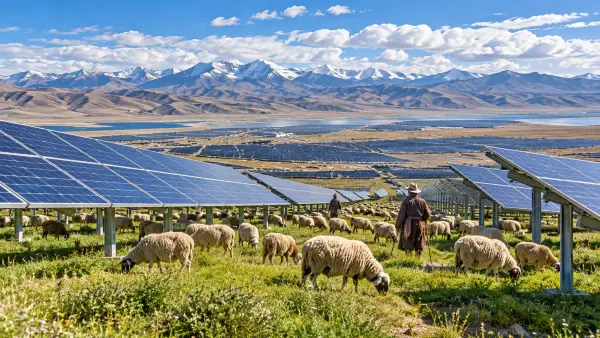
On the Tibetan Plateau in China’s Qinghai Province, engineers have triggered an unlikely transformation. The Talatan Gobi Desert, nearly 3,000 meters above sea level, was once defined by sandstorms, persistent drought, and almost no plant life at all. Today, rows of dark blue solar panels stretch toward the horizon in every direction, and beneath them, something nobody fully expected has happened: grass has returned, and local herders now bring their sheep to graze where there was once only sand and gravel.
Construction began in 2011, according to Chinese state media. Decades of drought and overgrazing had pushed desertification in the area to around 98.5 percent, leaving the land almost entirely barren and unproductive for farming or grazing alike. Local officials decided to leverage the region’s two greatest natural resources, strong, near-constant sunlight and vast, flat terrain, and began building a large-scale solar power hub on the plateau. The park stretches across several hundred square kilometers and is shared by dozens of solar companies.
What nobody fully predicted was how the panels themselves would change the ground beneath them. Rows of solar panels break the force of the wind, cutting erosion and reducing wind speed at ground level by roughly half, according to figures reported by Chinese state media. Their shade also lowers the temperature of the soil and slows evaporation by around 30 percent, the same reports say. Water used to clean dust from the panels seeps into the ground instead of running off uselessly, giving the soil just enough moisture to support plant life for the first time in decades.
As grass began to thrive between the rows of panels, a new problem appeared: nobody was cutting it. Tall grass can shade the panels themselves and reduce how much electricity they generate, so engineers needed a low-cost way to keep it in check without heavy machinery or scarce water. The solution already existed nearby. Local herders, including a man named Yehdor, began to graze their animals directly among the panels, and the practice quickly became widespread across the site. Chinese media soon gave the animals a nickname: “photovoltaic sheep.”
The arrangement works because it forms a self-reinforcing cycle. The livestock eat the grass, which keeps it short enough not to shade the panels, and their manure fertilizes the soil in turn, encouraging even more grass to grow the following season. Most of the numbers on this recovery come from park managers and state media. In July 2025, a park official told People’s Daily that vegetation covered more than 80 percent of the ground and that the park produced about 118,000 tonnes of grass a year. A 2022 China Daily report counted more than 20,000 sheep on the site, owned by herding families who had previously struggled to find usable grazing land.
How much of this has been measured independently? The question matters because the park is enormous: by the end of 2024, its grid-connected capacity had passed 17 gigawatts, according to Chinese state media. In a 2024 study in the journal Scientific Reports, researchers from Xi’an University of Technology compared ground inside one section of the park with land outside it. Using 57 indicators, from soil moisture and nutrients to the number of plant species, they rated conditions under the panels as “general,” while land outside the park still rated “poor.” This was an observational study at a single site, so it points to an improvement linked to the panels but cannot show how large or lasting that improvement will be.
There are also good reasons to doubt that this kind of transformation will repeat itself in every desert on Earth. The combination of shade, cleaning water, and grazing may work at Talatan partly because of its altitude, its soil, and an existing local herding culture ready to use the new grazing land. Grass that grows too thick creates its own risks, such as shading the panels and fueling fires in the dry season, which is one reason the grazing continues. Even so, the site offers a rare example of a power project that seems to sustain more life than it displaces, creating a small, engineered microclimate where almost none existed before it was built. What no study has yet tested is whether that microclimate would survive if the panels were ever removed.
Vocabulary
Each word has a frequency score, a rank, and a tag. The score shows how common the word is in modern English: higher means more common, and each full point means roughly ten times more common. The rank is the word’s position on a list of about 321,000 English word forms, from most to least common. The tag shows where you are most likely to meet the word: Current, Formal, Literary, or Dated. The paragraph number shows where the word first appears in the reading. The labels are information, not instructions. Deciding which words are worth your time is up to you. How to read the scores, ranks, and tags.
transformation (noun): a complete change in the form, appearance, or nature of something.
Frequency: 4.21 | Rank: 5,025 | Current | Paragraph 1
Translations: 转变 | 変貌(変化) | 변화(전환) | रूपांतरण | تحوّل | трансформация (преобразование) | transformación | transformation
- Engineers triggered an unlikely transformation in the desert landscape.
- The old factory underwent a complete transformation into apartments.
herders (noun, plural): people whose job is to look after and move groups of animals, such as sheep or cattle.
Frequency: 2.71 | Rank: 41,154 | Current | Paragraph 1
Translations: 牧民 | 牧畜民(羊飼い) | 목축민 | चरवाहे | رعاة (الماشية) | пастухи | pastores | bergers
- Local herders now bring their sheep to graze beneath the panels.
- Herders in the region have raised sheep for generations.
graze (verb): for an animal to eat grass or other plants growing in a field.
Frequency: 3.02 | Rank: 28,214 | Current | Paragraph 1
Translations: 放牧 | 放牧する | 방목하다 | चरना (पशुओं का) | يرعى (الماشية) | пастись | pastar | paître
- Local herders bring their sheep to graze between the rows of panels.
- The cows were left to graze in the open field all afternoon.
desertification (noun): the process by which fertile land gradually becomes desert, often due to drought or poor land use.
Frequency: 2.45 | Rank: 56,108 | Formal | Paragraph 2
Translations: 荒漠化 | 砂漠化 | 사막화 | मरुस्थलीकरण | التصحر | опустынивание | desertificación | désertification
- Decades of drought pushed desertification in the area to nearly 100 percent.
- Poor farming practices can speed up desertification in dry regions.
barren (adjective): having little or no plant life; not productive.
Frequency: 3.40 | Rank: 17,122 | Current | Paragraph 2
Translations: 贫瘠的 | 不毛の(荒れ果てた) | 척박한 | बंजर | قاحل (جرداء) | бесплодный (пустынный) | árido | stérile
- The land was almost entirely barren before the solar project began.
- Nothing grew on the barren hillside after years of drought.
leverage (verb): to use something you already have to get the greatest possible advantage.
Frequency: 3.88 | Rank: 8,542 | Formal | Paragraph 2
Translations: 利用(杠杆化) | 活用する(てこ入れする) | 활용하다 | लाभ उठाना (उपयोग करना) | يستفيد من (يستثمر) | использовать (задействовать) | aprovechar | tirer parti de
- Officials decided to leverage the region’s sunlight and flat terrain.
- The startup leveraged its small size to make decisions quickly.
erosion (noun): the gradual wearing away of soil or rock, often by wind or water.
Frequency: 3.64 | Rank: 12,216 | Formal | Paragraph 3
Translations: 侵蚀 | 浸食 | 침식 | अपरदन (मिट्टी का कटाव) | التآكل (تعرية التربة) | эрозия (выветривание почвы) | erosión | érosion
- The panels help cut erosion by reducing wind speed at ground level.
- Tree roots help prevent soil erosion on steep hillsides.
evaporation (noun): the process by which a liquid, such as water, turns into vapor and disappears into the air.
Frequency: 3.08 | Rank: 26,092 | Formal | Paragraph 3
Translations: 蒸发 | 蒸発 | 증발 | वाष्पीकरण | التبخر | испарение | evaporación | évaporation
- Shade from the panels slows evaporation, keeping the soil moist.
- Evaporation increases sharply on hot, windy afternoons.
thrive (verb): to grow, develop, or do well, often in unexpectedly good conditions.
Frequency: 3.73 | Rank: 10,680 | Current | Paragraph 4
Translations: 茁壮成长 | 繁茂する(生き生きと育つ) | 번성하다 | फलना-फूलना | يزدهر (ينمو بقوة) | процветать (пышно расти) | prosperar | prospérer
- Grass began to thrive unexpectedly between the rows of panels.
- The small business continued to thrive even during a difficult year.
livestock (noun): animals, such as sheep, cattle, or goats, that are kept and raised on a farm.
Frequency: 3.83 | Rank: 9,165 | Current | Paragraph 5
Translations: 牲畜 | 家畜 | 가축 | पशुधन | الماشية (الثروة الحيوانية) | домашний скот | ganado | bétail
- The livestock eat the grass and help keep it short enough for the panels.
- The farm keeps a small amount of livestock alongside its crops.
fertilizes (verb): adds nutrients to soil that help plants grow better.
Frequency: 2.61 | Rank: 46,473 | Current | Paragraph 5
Translations: 施肥 | 肥料を与える | 비료를 주다 | उर्वरक डालना (खाद देना) | يُسمّد (يخصّب التربة) | удобряет (почву) | fertiliza | fertilise
- The sheep’s manure fertilizes the soil, helping more grass grow.
- Farmers often fertilize their fields before the spring planting season.
capacity (noun): the maximum amount that something, such as a power plant, can produce or hold.
Frequency: 4.71 | Rank: 1,993 | Current | Paragraph 6
Translations: 装机容量(产能) | 発電容量(キャパシティ) | 용량(설비 용량) | क्षमता (उत्पादन क्षमता) | السعة (القدرة الإنتاجية) | мощность (установленная мощность) | capacidad | capacité
- The park’s grid-connected capacity passed 17 gigawatts by the end of 2024.
- The stadium has a seating capacity of about 40,000 people.
indicators (noun, plural): measurements or signs that show the state, level, or progress of something, such as soil health or an economy.
Frequency: 3.83 | Rank: 9,165 | Formal | Paragraph 6
Translations: 指标 | 指標 | 지표 | संकेतक | مؤشرات | показатели | indicadores | indicateurs
- The researchers used 57 indicators, including soil moisture and plant species.
- Unemployment and prices are key indicators of how an economy is doing.
sustain (verb): to keep something, such as life or an activity, continuing over time.
Frequency: 3.93 | Rank: 7,910 | Formal | Paragraph 7
Translations: 维持(维系) | 維持する(支える) | 유지하다 | बनाए रखना (सहारा देना) | يُبقي على (يديم) | поддерживать (сохранять) | sostener | soutenir
- The project seems to sustain more life than it displaces.
- A balanced diet helps sustain energy throughout a long day.
microclimate (noun): a small area with weather or growing conditions noticeably different from the surrounding region.
Frequency: 2.23 | Rank: 72,332 | Formal | Paragraph 7
Translations: 小气候(微气候) | 微気候 | 미기후 | सूक्ष्म जलवायु | مناخ محلي دقيق (المناخ الجزئي) | микроклимат | microclima | microclimat
- The shaded panels created a small microclimate where grass could grow.
- Tall buildings in a city can create their own microclimate.
Activity Page
Open the activity page in a new tab
Speed Challenge
Answer 12 questions against the clock. Every wrong answer adds 5 seconds, and the lowest score wins. Open the speed challenge in a new tab.
Comprehension Questions
- What was the Talatan Gobi Desert like before the solar farm was built, and how has it changed?
- Why did local officials choose this site for a large-scale solar power hub?
- How do the solar panels affect wind speed and evaporation at ground level?
- Why did engineers need a way to manage the grass growing under the panels, and what solution did they use?
- Where do most of the figures on the site’s recovery come from, according to paragraph 5?
- How does the cycle of grazing, manure, and grass growth work at the site?
- What did the 2024 study in Scientific Reports find, and what are its limits?
- Why might this kind of transformation not repeat in every desert?
- Do you think this project counts as restoring a “natural” ecosystem, or something else? Use evidence from the reading to explain your answer.
IELTS-Style Questions
- True, False, or Not Given: “The 2024 study found better conditions under the panels than on land outside the park.” Explain your answer using evidence from the reading.
- Yes, No, or Not Given: “The writer believes the Talatan results will repeat in every desert.” Explain your answer using evidence from the reading.
- Author’s purpose: Why does the writer point out that most figures come from park managers and state media, and then describe an independent study? Is the aim to reject the official figures, to help readers judge the evidence, or something else?
AI Discussion Prompt
I just read an article about a solar farm in China’s Gobi Desert that unexpectedly brought grass, sheep, and new life to barren land. It covered how the panels reduce wind erosion and evaporation, how grazing sheep help manage the grass that grows underneath, which figures come from officials and which from an independent study, and the limits of this kind of transformation. I am an English learner at about B2 level. Please ask me one question at a time, starting with what I already knew about solar power and deserts. Respond to my ideas first, then briefly correct any language errors, and ask follow-up questions that make me explain my reasoning.
AI Vocabulary Prompt
I want to practice vocabulary from an article about a Chinese solar farm that brought new life to a desert. Please quiz me on the following words one at a time, using a mix of question types: multiple choice, true/false, and sentence completion. Give me feedback after each answer before moving on, and bring back the words I miss later. Here are the words: transformation, herders, graze, desertification, barren, leverage, erosion, evaporation, thrive, livestock, fertilizes, capacity, indicators, sustain, microclimate.
Discussion Questions
- Before reading this, would you have guessed that a solar farm could help grass grow in a desert? What did you imagine deserts and solar farms had in common?
- Does it surprise you that engineers needed animals, not machines, to solve the problem of grass growing too tall?
- Have you ever seen a solar farm or a wind farm in person? What did the land around it look like?
- Many large projects, from dams to highways, change the land around them. Can you think of one that changed land for the worse?
- In your country, are there any large solar or wind energy projects? What effects, positive or negative, have they had on local communities or land?
- The herders in the story benefited directly from the solar farm through new grazing land. Can you think of other examples where a big project unexpectedly helps local people?
- The reading says thick grass can fuel fires in the dry season. Do you think unexpected problems like this are common in large engineering projects?
- Most figures in the reading come from park managers and state media. How much should readers trust figures from the people who run a project?
- Would you call Talatan a success for the environment, for energy, or for both? What evidence would change your mind?
- If you were a local government official, would you want a project like this in your area? What questions would you ask before agreeing to it?
- Large solar farms are often built in remote, sparsely populated regions. Who do you think should benefit most from the electricity and jobs they create?
- Would you consider herding sheep under solar panels an attractive job? What skills do you think it would require?
- Why might it be hard for independent scientists to study a large project like this one? What would make their work easier?
- Deserts that look empty are still ecosystems. Should any deserts be protected from solar development, even if panels might help plants grow?
Language Focus: Cause and Effect Language
What it is: Cause and effect language shows how one thing leads to another. Writers use connecting words and phrases such as so, which, giving, and creating to link a cause to its effect, especially when describing a chain of changes.
Why writers use it: This reading describes a chain of causes and effects: shade leads to less evaporation, which leads to grass, which leads to grazing animals, and so on. Recognizing these connectors helps you follow how one change leads to another in a complex process.
Examples from the reading:
- “Tall grass can shade the panels themselves and reduce how much electricity they generate, so engineers needed a low-cost way to keep it in check…”
- “The livestock eat the grass, which keeps it short enough not to shade the panels…”
- “Water used to clean dust from the panels seeps into the ground instead of running off uselessly, giving the soil just enough moisture to support plant life…”
- “…the site offers a rare example of a power project that seems to sustain more life than it displaces, creating a small, engineered microclimate…”
Practice task: Rewrite this sentence using a cause-and-effect connector: “The panels provide shade. The soil stays cooler and moister.”
(Example answer: “The panels provide shade, which keeps the soil cooler and moister.”)
Recommended Resources
- Desert Solar Panels Foster Greening, Animal Husbandry Efforts (Xinhua / China Daily). A 2025 Xinhua report on how the panels, grass, and sheep work together at Talatan.
- Solar-Powered Sheep (China Daily). A 2022 report on the “photovoltaic sheep” and the herders who graze them among the panels.
- Assessment of the Ecological and Environmental Effects of Large-Scale Photovoltaic Development in Desert Areas (Scientific Reports). The 2024 study from Xi’an University of Technology that compared land inside and outside the park. Advanced, but the abstract is readable.
- Large-Scale PV Has Positive Environmental Effect on Desert Areas (pv magazine). A short news summary of the same study, written for a general audience.
- NW China’s Qinghai Combats Desertification Through Solar Power Generation and Animal Husbandry (People’s Daily). A 2025 report with a park official’s figures on grass cover and grass production, and a herder’s view.